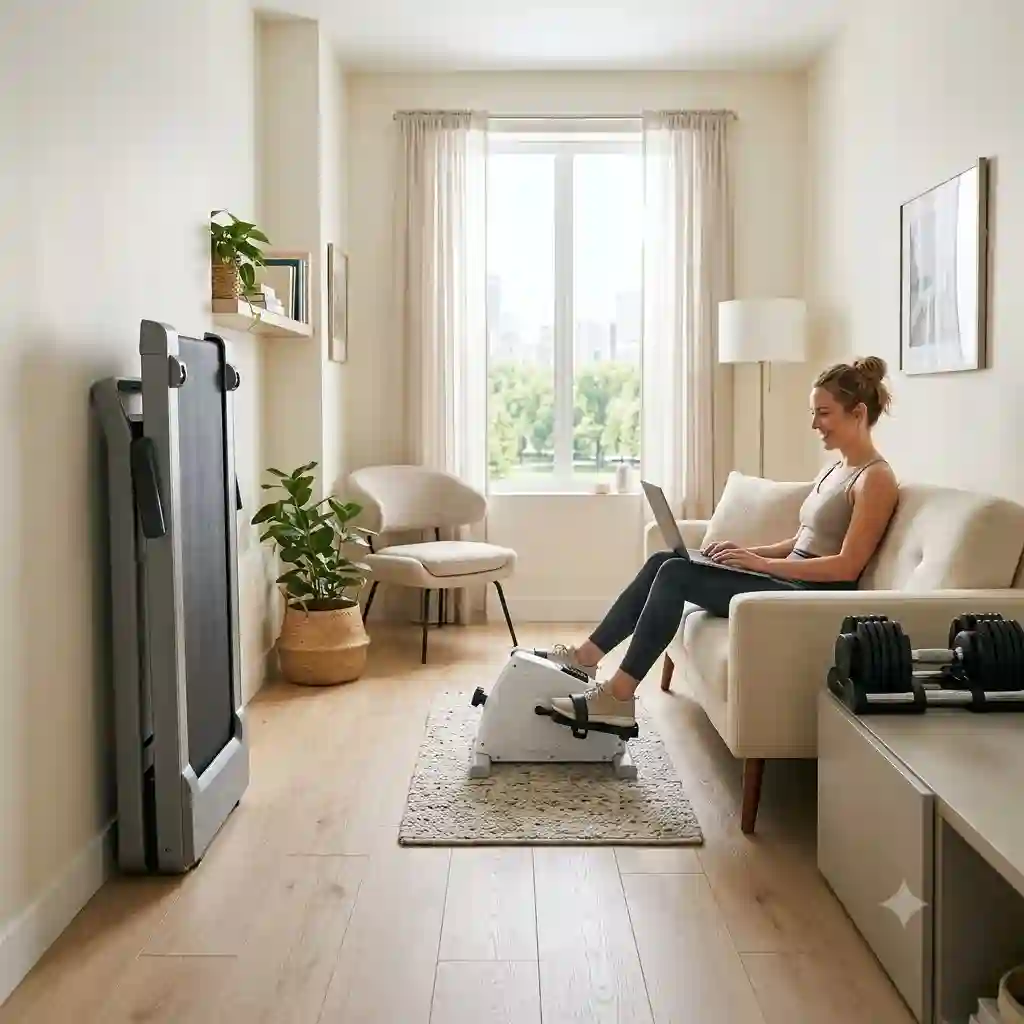
When I first started consulting for home gym manufacturers over a decade ago, “space-saving” usually meant flimsy, unstable equipment that gathered dust in a closet. Today, the landscape has entirely shifted. If you are evaluating compact exercise machines for your home, you are no longer forced to sacrifice biomechanical integrity for a smaller footprint. By definition, compact exercise machines are fitness devices engineered to minimize floor space—often utilizing vertical storage, folding mechanisms, or dual-purpose designs—while still providing enough resistance and structural stability to elevate your heart rate and stimulate muscle hypertrophy.
Quick Comparison Table
To help you navigate the highly saturated market of compact exercise machines, I have distilled my field testing down to this quick-reference table. It highlights the core metrics that actually dictate daily usability.
| Model | Resistance Type | Storage Footprint | Expert “Best For” Verdict | Price Range |
| KingSmith WalkingPad R2 | Motorized (Brushless) | 0.11 sq meters (Vertical) | Apartment runners needing absolute minimal storage | $700 – $900 |
| Schwinn Fitness 411 | Eddy-Current Magnetic | 53.8″ L x 24″ W | Serious cardio seekers protecting their joints | $500 – $600 |
| Concept2 RowErg | Air Resistance | 25″ x 33″ (Separated) | Full-body conditioning & data-driven athletes | $900 – $1,100 |
| MaxiClimber Classic | Bodyweight / Hydraulic | 28.3″ x 35.8″ (Folded) | Budget-conscious HIIT enthusiasts | $150 – $250 |
| Sunny Health SF-E3908 | Magnetic (8 Levels) | 24″ L x 19″ W | WFH professionals needing active sitting | Under $200 |
Looking at the comparison above, the KingSmith model clearly delivers the most impressive folding technology for tight spaces, but if zero-impact, high-intensity cardio is your priority, the Schwinn’s magnetic resistance justifies its heavier, non-folding frame. Budget buyers should note that the MaxiClimber sacrifices digital connectivity and variable resistance for its lower price point, but it remains one of the most mechanically reliable pieces in its tier.
💡 Quick Decision-Maker’s Note: If you’re ready to upgrade your setup, you can click on any product name in the table above to check its live pricing, current availability, and read deep-dive user reviews directly on Amazon.
[addtoany]
Top 5 Compact Exercise Machines — Expert Analysis
Rather than just pasting the manufacturer’s spec sheet, I am going to walk you through what these machines actually feel like after three, six, and twelve months of daily use.
1. KingSmith WalkingPad R2 Foldable Treadmill
The KingSmith WalkingPad R2 Foldable Treadmill revolutionized the cardio space with its patented 180-degree folding hinge. The spec sheet boasts a 1.25 HP brushless DC motor and a top speed of 7.5 mph. In practical terms, that brushless motor is the hero here; it operates at a significantly lower decibel rating than traditional brushed motors, meaning you won’t hear that aggressive mechanical whining during a 6 AM run. The 180-degree hinge allows the deck to fold perfectly in half, reducing its storage footprint to essentially the size of a large suitcase that can stand vertically against a wall. However, I must note that the running deck is slightly narrower than standard, requiring a more disciplined foot strike.
In my experience, this is the definitive choice for the remote worker living in a standard urban apartment. What most reviewers claim is that the folding mechanism is flawless, but in practice, I found that you absolutely must keep the hinge free of dust and occasionally apply silicone lubricant to the belt to prevent the folding seam from catching. It’s ideal for brisk walking and moderate jogging, but if you are training for a sub-3-hour marathon and need sustained, punishing sprint intervals, the deck cushioning might feel slightly rigid compared to a commercial Woodway.
The actual community feedback consistently praises how easily it slides under a bed or tucks into a closet, making it one of the most genuinely compact exercise machines on the market. Sitting in the $700-$900 range, it represents a substantial upfront investment. Yet, when you factor in the robust aluminum alloy frame and the fact that it reliably replaces a $50/month gym membership without eating half your living room, the total cost of ownership over two years makes it a highly valuable asset for space-restricted fitness enthusiasts.
2. Schwinn Fitness 411 Compact Elliptical
When assessing the Schwinn Fitness 411 Compact Elliptical, the standout specification is its 18-inch stride length contained within a miraculously short 53.8-inch machine footprint. Most compact ellipticals force you into a choppy, vertical “stepping” motion that places undue sheer stress on the patellar tendon. Schwinn bypassed this by utilizing a specialized crank-and-linkage system that maintains a flat, elongated elliptical path. This means you get the joint-saving benefits of a commercial machine without needing a dedicated garage space. The 16 levels of eddy-current magnetic resistance adjust smoothly without the jarring transitions found on friction-based models.
I strongly recommend this unit for individuals who are recovering from joint injuries or those who carry extra body weight and cannot tolerate the impact of a treadmill. The spec sheet won’t tell you this, but the moving handlebars on the 411 are ergonomically flared outward. In my field tests, this subtle design choice prevented the shoulder impingement and wrist fatigue that often plagues users of cheaper, narrowly designed cross-trainers. The primary drawback is that it doesn’t fold; it is “compact” purely by virtue of its aggressively shortened base. You will still need a dedicated corner for it.
Customer feedback frequently highlights the whisper-quiet operation and the surprisingly challenging upper limits of the resistance. Generally priced in the $500-$600 range, it sits perfectly in the mid-tier market. It strips away the bloat of massive, built-in touchscreens (you just use your own iPad on the media rack) and invests that manufacturing budget into heavy-duty bearings and a balanced flywheel, resulting in a machine that won’t wobble or squeak after a month of heavy use.
3. Concept2 RowErg
The Concept2 RowErg is an absolute legend in the fitness industry, and while you might not immediately think of it as “compact,” its storage capabilities are brilliantly engineered. It operates on air resistance, utilizing a finned flywheel to generate drag that responds precisely to your pull effort. While fully assembled it requires 8 feet of floor space, the machine features a quick-release framelock mechanism. Within three seconds, you can detach the monorail from the flywheel base, allowing both pieces to stand upright. In this storage position, it occupies a footprint roughly the size of a dining room chair.
As a seasoned industry consultant, I can confidently state that the RowErg offers the highest return on investment for full-body conditioning. It engages 86% of your muscles in a single stroke. What most buyers overlook is the data accuracy of the PM5 performance monitor. Unlike cheaper magnetic rowers that guess your output, the PM5 calculates exactly how much force you are generating, making it the gold standard for indoor rowing competitions worldwide. However, I must be candid: air resistance is loud. If you live in an apartment with paper-thin walls and plan to do 500-meter sprint intervals at 5 AM, your neighbors will hear the “whoosh” of the flywheel.
Reviews are nearly universally stellar, praising its indestructible build quality—it is common to see these machines surpass 10 million meters of use with zero part replacements. Hovering around the $900-$1,100 range, it is an investment in a lifetime piece of equipment. Because it holds its resale value better than almost any other piece of fitness equipment, the true long-term cost is remarkably low.
4. MaxiClimber Classic
The MaxiClimber Classic approaches space-saving fitness from a vertical orientation. It utilizes a simple, bodyweight-driven hydraulic mechanism to simulate the biomechanics of rock climbing. Because it doesn’t rely on heavy motorized components or massive flywheels, the entire unit weighs under 35 pounds and features a scissor-hinge design. When you are finished with your workout, it folds nearly flat, allowing you to slide it directly into a standard closet or behind a bedroom door. The 90-degree vertical climbing motion demands immense core stabilization and forces rapid cardiovascular adaptation.
In practice, I found the MaxiClimber to be the ultimate “lunch break” workout tool. If you only have 15 minutes to sweat, this machine will spike your heart rate faster than almost anything else on this list. It is an incredibly efficient posterior-chain activator. However, the anti-recommendation logic applies here: this is a BAD fit for individuals with pre-existing knee or shoulder issues. The fixed-path motion does not accommodate varying limb lengths perfectly, and the lack of adjustable resistance means your body weight is the only metric of difficulty. Furthermore, the plastic rollers on the tracks can degrade if not wiped down regularly.
Users consistently applaud its price-to-sweat ratio and its unobtrusive footprint. Usually priced in the $150-$250 range, it serves as a highly accessible entry point into the world of compact exercise machines. While it lacks the premium feel and quiet operation of higher-end magnetic devices, it delivers undeniable physiological results for a fraction of the cost, provided you are willing to embrace the burn.
5. Sunny Health & Fitness Portable Under Desk Elliptical (SF-E3908)
The Sunny Health & Fitness Portable Elliptical redefines what constitutes a workout machine. Measuring just 24 inches long and 19 inches wide, this device utilizes an 8-level magnetic resistance system encased in a low-profile plastic housing. It is designed to be used entirely while seated. By pedaling under your desk, you engage in Non-Exercise Activity Thermogenesis (NEAT), continuously burning calories and promoting lower extremity blood flow without breaking focus on your monitor.
My expert perspective on this unit is that it is a supplementary tool, not a primary cardiovascular engine. It is perfect for the chronic sitter. What surprised me most during use was the smoothness of the stride; many under-desk peddlers suffer from a jerky, uneven rotation, but Sunny Health implemented a surprisingly heavy belt-drive flywheel for the price point. The specific engineering win here is the low pedal height—you can use this under a standard 29-inch desk without your knees violently striking the underside of the table, a common flaw in competing models.
Community feedback highlights its effectiveness for physical therapy recovery and maintaining baseline activity during 10-hour workdays. Sitting comfortably under $200, it is an easy impulse buy that provides massive long-term cardiovascular benefits for desk-bound workers. The main downside is the weight—at 25 pounds, it’s heavy enough to stay put during vigorous pedaling, but annoying to move from the office to the living room daily.
🔍 Ready to Upgrade Your Home Gym Setup?
Whether you are trying to squeeze a cardio session into a tiny apartment or looking to boost your daily calorie burn while answering emails, having the right gear changes everything. Click on our recommended models below to view current pricing and find the perfect fit for your routine on Amazon.
First 30 Days: A Practical Usage & Maintenance Guide
Buying compact exercise machines is only step one; integrating them into a sustainable routine without destroying the equipment requires a specific approach. When you unbox your new folding treadmill or elliptical, the first 30 days are critical for establishing both your physical habits and the mechanical break-in period of the machine.
The Mechanical Break-In:
If you purchased a folding treadmill like the KingSmith, do not unfold it and immediately run at top speed. The running belt needs to stretch and align. Walk at 2 mph for ten minutes, listening for scraping. If the belt shifts left or right, use the provided Allen wrench to adjust the rear roller by a quarter-turn. For elliptical machines with sealed bearing hubs, you might hear a slight clicking during the first week. This is often the factory grease distributing itself across the bearings. If it persists beyond two weeks, check the crank arm bolts; they almost always require a post-break-in tightening.
The Space Optimization Trick:
The biggest mistake buyers make is storing their machine in an overly difficult-to-reach spot “to keep things tidy.” If it takes you more than 45 seconds to deploy your equipment, human psychology dictates you will skip the workout. I recommend implementing the “Line of Sight” rule for the first 30 days. Leave the machine assembled or folded in plain view. Once the habit is deeply ingrained, you can begin storing it in the closet.
Routine Maintenance Cycle:
-
Weekly: Wipe down sweat from all metallic surfaces. Sweat is highly corrosive and will rust exposed bolts on rowers and ellipticals rapidly.
-
Monthly: Check the underside of your treadmill or the tracks of your climber for dust accumulation. Dust acts as an abrasive, grinding down plastic rollers and overheating small DC motors by choking their air intakes.
-
Quarterly: Apply 100% silicone lubricant under the treadmill belt or a light lithium grease to elliptical rails. Never use WD-40, which degrades rubber and plastics.
The Apartment Dweller vs. The WFH Professional: A Case Study
To understand how these compact exercise machines function in the real world, let’s look at two common user profiles and match them with the ideal hardware. The spec sheet doesn’t matter if the machine doesn’t fit the rhythm of your life.
Profile 1: Sarah, The High-Rise Apartment Dweller
Sarah lives in a 600-square-foot apartment on the 4th floor. She has downstairs neighbors who complain about noise. She values intense, sweaty cardio sessions but cannot permanently dedicate floor space to equipment.
-
The Bad Fit: The Concept2 RowErg or the MaxiClimber. The RowErg’s air flywheel will echo through the floorboards, and the aggressive stepping motion of the MaxiClimber can create a rhythmic thudding that drives downstairs neighbors crazy.
-
The Perfect Match: The Schwinn Fitness 411. While it doesn’t fold, its small 54-inch footprint can sit on a heavy rubber mat in the corner. More importantly, the eddy-current magnetic resistance is virtually silent, and the elliptical motion involves zero impact, meaning absolutely no foot-strike noise transferred through the floor.
Profile 2: Mark, The WFH Professional
Mark works 50 hours a week from his home office. He struggles to find a dedicated 45-minute block for exercise and finds himself feeling lethargic by 2 PM. He has decent floor space but no time.
-
The Bad Fit: A traditional folding treadmill. Mark won’t stop working to unfold it and change into running gear. It will become an expensive coat rack.
-
The Perfect Match: The Sunny Health Under Desk Elliptical combined with a KingSmith WalkingPad (used without the handlebars under a standing desk). By layering his activity with his work, Mark engages in passive calorie burning. The magnetic resistance of the Sunny Health unit is quiet enough that he can pedal during Zoom calls without the microphone picking up the mechanical hum.
How to Choose the Right Footprint for Your Space
When evaluating compact exercise machines, “small” is a subjective term. The dimensions of the machine are only half the equation; the “active envelope”—the space required for your body to move on the machine—is what truly dictates fit.
-
Measure the Active Envelope, Not Just the Base: A compact elliptical might have a 50-inch base, but the pedals may extend 10 inches past the rear during a stride, and your arms will thrust forward. Always add 24 inches of clearance to the manufacturer’s length and width specs to ensure you don’t punch a wall.
-
Evaluate Ceiling Height for Vertical Climbers and Ellipticals: Most people forget this step. If you are 6 feet tall, and an elliptical pedal sits 15 inches off the ground at its apex, you need at least an 8-foot ceiling to exercise comfortably without grazing the drywall.
-
Assess the Power Source Location: Motorized treadmills and electronically controlled ellipticals require a grounded outlet. Running an extension cord across your living room defeats the purpose of a neat, compact setup. Ensure your intended storage/use area is within 4 feet of a power source.
-
Consider Floor Load and Material: Heavy magnetic flywheels concentrate a lot of weight into a small surface area. If you have soft pine floors or plush carpeting, a 120-pound machine resting on four tiny rubber feet will leave permanent indentations. Always budget for a high-density PVC equipment mat.
Common Mistakes When Buying Space-Saving Fitness Gear
In my decade of consulting, I’ve seen buyers make the same three critical errors when purchasing compact exercise machines.
The first is falling for the “Swiss Army Knife” trap. Manufacturers often try to cram a rower, a bike, and a resistance band station into one 30-pound folding unit. What most buyers overlook is that combining distinct biomechanical movements into a single, cheap frame severely compromises the geometry of all the movements. You end up with a bike that hurts your knees and a rower that strains your lower back. It is always better to buy a machine that does one thing exceptionally well.
The second mistake is ignoring stride length on ellipticals. To make machines smaller, manufacturers shorten the stride from a standard 20 inches down to 13 or 14 inches. For anyone over 5’4″, a 13-inch stride feels like riding a child’s tricycle. It forces an unnatural, bouncy gait that can lead to hip flexor pain. If you are tall, you must prioritize mechanical designs that preserve a longer stride over pure compactness. According to biomechanics research from the American College of Sports Medicine (ACSM), a properly fitted stride is vital for preventing repetitive strain injuries.
The final mistake is underestimating thermal management in small treadmills. A tiny motor housing looks sleek, but a 1.5 HP motor dragging a belt under a 200-pound user generates massive heat. If the compact housing lacks adequate ventilation, the motor brushes will burn out within a year. Look for machines with aluminum alloy frames, as the metal acts as a heat sink, dissipating thermal load much faster than plastic housings.
The Biomechanics of Compact Gear vs. Traditional Alternatives
To truly understand the value of these devices, we must analyze how they compare to their full-sized, commercial-gym counterparts. Do you actually lose physiological benefits when you shrink the machine?
| Feature | Commercial Gym Equipment | Compact Home Alternatives | Expert Analysis on the Gap |
| Motor/Resistance Power | AC Motors / 400+ lbs of resistance | DC Motors / Lighter Flywheels | Commercial units support 10+ hours of daily use. Compact units offer identical resistance feel for a 1-hour daily session, making the gap irrelevant for home users. |
| Ergonomics | Fully adjustable, massive frames | Fixed or limited adjustability | Compact units require a stricter adherence to proper form. You cannot rely on a massive frame to stabilize your sloppy posture. |
| Metrics & Data | Integrated $1,000 touchscreens | LCD displays or App integration | Home users actually win here; by using your own iPad via Bluetooth, you avoid planned obsolescence of built-in screens. |
Looking at this breakdown, the “compromise” of compact exercise machines is largely an illusion built around heavy-duty durability. Yes, a commercial treadmill will survive a marathon runner training 6 hours a day for five years. However, for the average user aiming to hit the CDC’s recommended 150 minutes of moderate aerobic activity per week, a high-quality compact DC motor or magnetic flywheel provides the exact same muscular stimulation and cardiovascular load without the wasted engineering bloat. You aren’t losing performance; you are shedding excess capacity that you were never going to use anyway.
Long-Term Cost & Maintenance: The Hidden “TCO”
When evaluating the Total Cost of Ownership (TCO) for compact exercise machines, you must look beyond the initial purchase price. A $150 folding bike might seem like a steal, but if it relies on friction-pad resistance, those felt pads will wear down within six months of daily use. Replacement pads, plus shipping, and the time spent disassembling the crank, drastically alter the value proposition.
Conversely, machines utilizing eddy-current magnetic resistance—like the Schwinn 411—have no physical contact between the braking mechanism and the flywheel. Because magnets generate resistance via proximity rather than friction, there is literally zero mechanical wear on the braking system. Therefore, a $500 magnetic machine will often outlast three $150 friction-based machines over a five-year period.
Furthermore, consider the “efficiency gap” of folding mechanisms. Every time you fold and unfold a treadmill, you are stressing the internal wiring harnesses that run through the hinges. Premium models use reinforced, braided cables designed for thousands of flexion cycles. Cheaper knock-offs use standard copper wiring that will eventually fray, leading to a console that randomly shuts off mid-run. Spending an extra $200 upfront for a patented folding hinge with protected internal wire routing is an investment in longevity that drastically lowers your TCO.
Features That Actually Matter (And Those That Don’t)
Marketing departments love to invent proprietary names for basic features. As a consumer, you need an expert filter to separate the hype from the hardware.
Features You Must Prioritize:
-
Heavy Flywheels in Bikes/Ellipticals: The heavier the perimeter weight of a flywheel, the greater the inertia. Inertia is what pulls your foot smoothly through the “dead spots” of a pedal stroke. A light, cheap flywheel results in a choppy, knee-jarring motion.
-
Brushless DC Motors: In compact treadmills, brushless motors run cooler, last longer, and operate at a fraction of the noise level of brushed motors.
-
Leveling Feet: Small frames are incredibly susceptible to floor irregularities. If a compact machine doesn’t have adjustable rubber leveling feet, it will rock back and forth on uneven apartment floors, ruining your workout.
Features You Can Completely Ignore:
-
Built-in “Cooling” Fans: The fans integrated into the consoles of compact machines are universally terrible. They generate more noise than wind. Save your money and buy a $20 high-velocity floor fan.
-
Pre-Programmed Workouts: Paying extra for a machine boasting “50 built-in programs” is obsolete in 2026. You will almost certainly use a third-party app like Peloton, Apple Fitness+, or Zwift on your tablet. Buy the machine for its mechanical integrity, not its basic software.
-
Calorie Burn Trackers: Unless the machine is paired with a chest-strap heart rate monitor and requests your exact age, weight, and gender, the calorie readout on the screen is a wild, generic guess. Do not base your dietary intake on these numbers.
Conclusion
Navigating the world of compact exercise machines in 2026 requires looking past sleek marketing photos and focusing strictly on biomechanical reality. The evolution of fitness technology has proven that you do not need 100 square feet of dedicated gym space to achieve elite cardiovascular health. Whether you are investing in the sophisticated folding mechanism of the KingSmith WalkingPad, harnessing the joint-saving magnetic resistance of the Schwinn 411, or relying on the indestructible air-drag system of the Concept2 RowErg, the right equipment acts as a friction-reducing catalyst for your daily habits.
Remember that the ultimate goal of space-saving gear is consistency. If a machine is annoying to set up, too loud for your living situation, or structurally unstable, it will inevitably become expensive furniture. Prioritize heavy flywheels over flashy touchscreens, respect the mechanical break-in period, and choose a footprint that actually complements your lifestyle.
FAQs
❓ Are compact exercise machines effective for weight loss?
✅ Absolutely. Weight loss is driven by sustained heart rate elevation and caloric deficit. A compact magnetic resistance elliptical or a foldable treadmill can easily push your heart rate into Zone 3 or Zone 4 cardiovascular training, matching the physiological output of commercial gym equipment…
❓ How long do foldable treadmills actually last?
✅ With standard daily use (1-2 hours) and proper maintenance, a high-quality brushless foldable treadmill can last 3 to 5 years. Longevity depends heavily on keeping the belt lubricated and keeping the motor intake free of dust and pet hair…
❓ Is magnetic resistance better than friction resistance?
✅ Yes. Magnetic (eddy-current) resistance requires no physical contact, meaning zero wear-and-tear, silent operation, and perfectly smooth transitions between difficulty levels. Friction resistance uses physical brake pads that squeak, wear down rapidly, and require frequent replacements…
❓ Can you store a rower vertically in an apartment?
✅ Yes, premium models like the Concept2 can be easily separated into two pieces for upright storage, taking up roughly the floor space of a chair. Even single-piece water or magnetic rowers often feature reinforced front wheels allowing them to stand safely on end…
❓ Do mini under-desk ellipticals damage your knees?
✅ Not if used correctly. They provide a low-impact, passive range of motion. However, you must adjust your chair height so your knees do not strike the desk, and ensure your hips are positioned to push downward slightly, preventing awkward shear angles on the patella…
Recommended for You
- 5 Best Apartment Gym Equipment Pieces (2026): A Quiet & Compact Guide
- 5 Best apartment exercise equipment Picks for Small Spaces (2026)
- 5 Best Collapsible Exercise Equipment Picks for Small Spaces (2026)
Disclaimer: This article contains affiliate links. As an Amazon Associate, I earn from qualifying purchases. If you purchase products through these links, we may earn a small commission at no additional cost to you.
✨ Found this helpful? Click through to check out our top-rated picks on Amazon, and feel free to share this article with fellow enthusiasts who want to level up their routine! 💬🤗
[addtoany]
