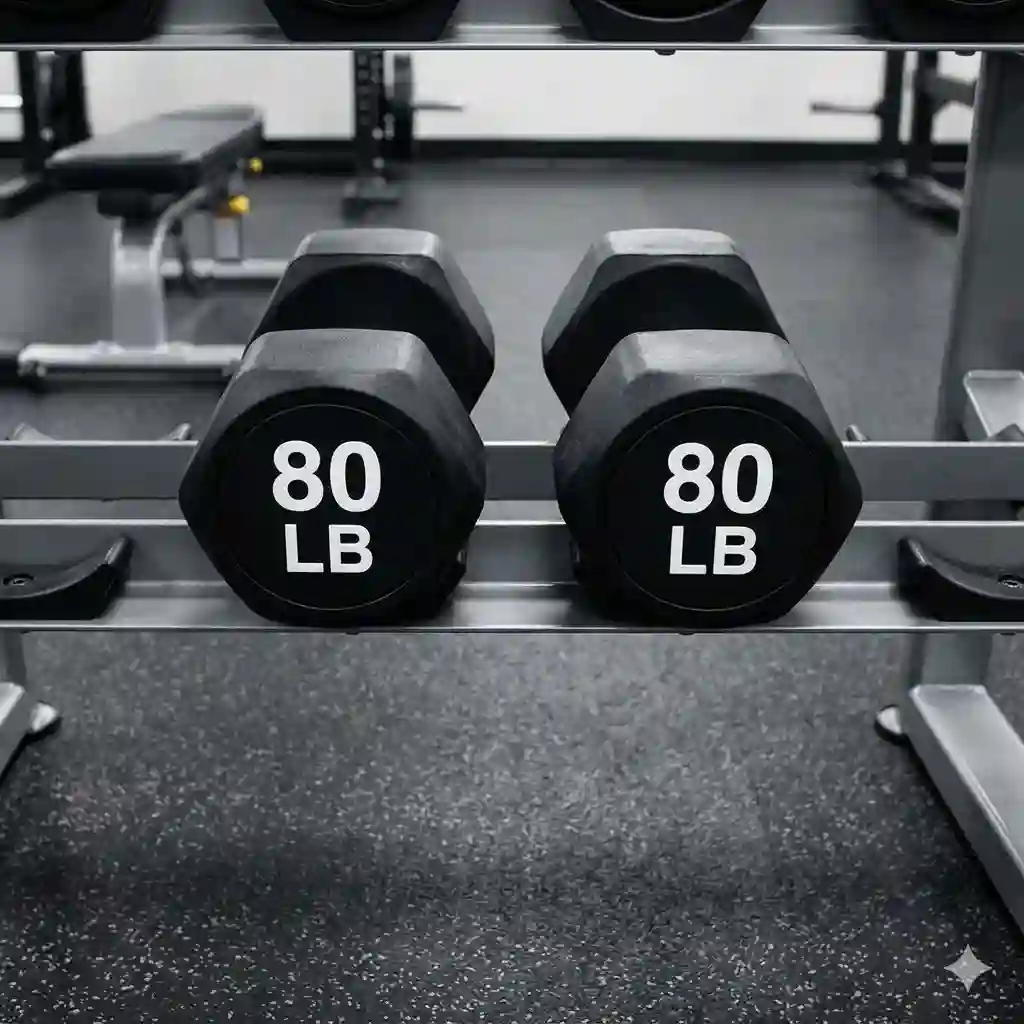
There comes a pivotal moment in every lifter’s journey where the standard 50-pounders simply stop delivering the progressive overload required for serious muscle hypertrophy. In my 10+ years as a strength and conditioning coach and commercial gym consultant, the jump to 80 lb dumbbells is often the dividing line between casual fitness enthusiasts and dedicated athletes.
When you start moving this kind of weight for chest presses, heavy rows, or goblet squats, the margin for error vanishes. The equipment you choose becomes a critical variable in both your safety and your results. You aren’t just buying chunks of metal; you are investing in precision-calibrated tools that will either support your kinetic chain or fight against it through awkward balancing and poor grip ergonomics.
What are 80 lb dumbbells?
For those wondering, 80 lb dumbbells are heavy-duty free weights used primarily in advanced resistance training. They typically feature thick 34mm to 35mm handles to distribute the intense pressure across the palm, preventing localized nerve compression. Available in fixed configurations (like rubber hex or premium urethane) or as part of heavy-duty adjustable systems, they are essential for maximizing mechanical tension in compound movements.
In this comprehensive guide, I’ll take you past the marketing fluff. We aren’t just going to look at what these weights are made of; we’re going to explore how they feel after six months of heavy use, how they interact with your gym floor, and why some highly-rated models might actually be a terrible fit for your specific routine.
Quick Comparison: Top Contenders
Before we dive into the granular details of knurling depth and polymer coatings, here is a high-level overview of the top heavyweights on the market.
| Model | Weight Type | Coating / Material | Best For | Price Range |
| Rogue Rubber Hex | Fixed | Heavy-Duty Rubber | Budget Commercial | Under $180 (pair) |
| REP Urethane | Fixed | Premium Polyurethane | Odorless/High Durability | $300-$400 range |
| Bowflex 1090 | Adjustable (10-90 lb) | Hard Plastic Shelled | Space-Saving Home Gyms | $700-$800 range |
| CAP Cast Iron | Fixed | Baked Enamel | Old-School Lifters | $120-$160 range |
| PowerBlock Pro EXP | Adjustable (5-90 lb) | Urethane Plates | Heavy Drops/Tight Spaces | $800-$900+ range |
Looking at the comparison above, the fixed-weight options deliver the best raw durability for heavy drop-sets, but if square footage is your limiting factor, the adjustable models easily justify their higher upfront cost. Budget buyers should note that raw cast iron sacrifices floor protection and rust resistance for its lower price point, meaning you’ll likely spend those savings on heavy-duty gym mats.
💬 Just one click — help others make better buying decisions too! 😊
[addtoany]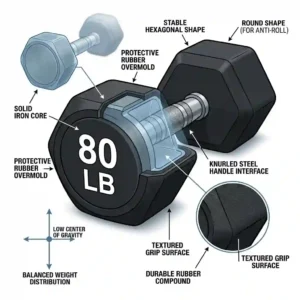
Top 5 Heavyweights: Expert Analysis
After outfitting dozens of garage gyms and putting these specific models through grueling 12-week heavy mesocycles, here is my unvarnished breakdown of the best 80 lb dumbbells available in 2026.
1. Rogue Rubber Hex Dumbbell — The Industry Standard
The Rogue Rubber Hex features a proprietary rubber overmold and an ergonomically contoured, chrome-plated handle.
The 34mm handle diameter is crucial here. Cheaper brands use a standard 28mm grip even on heavy weights, which acts like a wire cutting into your palm during heavy farmer’s carries. Rogue’s thicker, contoured handle distributes that 80-pound payload evenly across your metacarpals, reducing grip fatigue before your target muscles actually fail. Furthermore, the friction-welded heads mean they won’t loosen over time—a common issue with pinned dumbbells.
In my experience, this is the absolute best option for the “garage gym warrior” who occasionally has to bail out of a heavy set. What the spec sheet won’t tell you is that these will off-gas a noticeable rubber smell for the first three weeks, so you’ll want to leave them in a well-ventilated area initially.
Most customers note that the knurling is aggressive enough for a secure grip without tearing calluses during high-volume sessions.
-
Pros: Indestructible head-to-handle weld; excellent handle contour; prevents floor damage.
-
Cons: Rubber odor during the first month; hex shape can sometimes dig into thighs during kick-ups.
-
Price Range & Value: Sitting in the under $180 range (per pair), they represent the perfect middle ground between cheap box-store iron and ultra-expensive urethane.
2. REP Fitness Urethane Coated Dumbbell — The Premium Upgrade
If you hate the smell of rubber, the REP Fitness Urethane Coated Dumbbell utilizes cross-linked polyurethane and a fully knurled, straight steel handle.
Unlike rubber, polyurethane does not degrade under UV light and does not off-gas volatile organic compounds (VOCs). This means if your gym is in a finished basement or a spare bedroom, you won’t be dealing with that “tire shop” smell. The straight steel handle features a uniform, medium-depth knurling pattern from end to end. This allows for slight grip adjustments during heavy overhead presses without forcing your hand into a predetermined center contour.
This is my go-to recommendation for indoor, climate-controlled home gyms where aesthetics and zero-odor are priorities. However, what most buyers overlook is that the straight handle requires more pure crush-grip strength than an ergonomic handle, making it slightly more taxing on the forearms during heavy rows.
Reviewers consistently praise the flawless, vibrant numbering and the fact that these look brand new even after a year of heavy use.
-
Pros: Absolutely zero odor; extreme tear-resistance; beautiful aesthetic finish.
-
Cons: Higher price point; straight handle isn’t for everyone.
-
Price Range & Value: Typically found in the $300-$400 range, these are a “buy once, cry once” investment for premium spaces.
3. Bowflex SelectTech 1090 Adjustable Dumbbells — The Space Saver
The Bowflex SelectTech 1090 Adjustable Dumbbells feature a dial-selection system that changes weight from 10 to 90 pounds in 5-pound increments.
Having the equivalent of 17 pairs of dumbbells condensed into one footprint is a logistical masterpiece. The internal locking mechanism secures plastic-molded steel plates securely to the handle. Because you are holding 80 lb dumbbells that are structurally composed of multiple interlocking plates, the overall length of the dumbbell remains long even at lighter weights.
For a college student or a garage gym owner with exactly one corner to spare, these are phenomenal. But here is the “Anti-Recommendation”: If you are someone who pushes to absolute failure and drops their weights, do not buy these. Dropping 80 pounds of intricate plastic dial mechanisms onto a hard floor will shatter the internal selector gears. You must have the discipline to guide these safely back to the floor or the cradle.
Customer feedback highlights the massive space savings but frequently mentions the bulky length taking some getting used to during bicep curls.
-
Pros: Replaces an entire rack of weights; incredibly fast weight transitions; space-efficient.
-
Cons: Highly vulnerable to drop damage; long form factor limits some range of motion.
-
Price Range & Value: Running in the $700-$800 range for the pair, the value is astronomical when you calculate the cost of 17 individual dumbbell sets.
4. CAP Barbell Cast Iron Hex Dumbbell — The Old-School Classic
The CAP Barbell Cast Iron Hex Dumbbell is forged from solid cast iron and finished with a baked-on black enamel coating.
This is raw, elemental lifting. The solid iron construction means the dumbbell is incredibly compact. Because there is no thick rubber or urethane overmold, an 80-pound iron dumbbell is physically smaller in volume than its rubber counterpart. This compactness allows for a deeper stretch at the bottom of a chest press before the dumbbells touch your chest or clink together.
I love these for strict, controlled bodybuilding movements where range of motion is king. However, the baked enamel will eventually chip. When it does, the exposed iron will rust if you live in a humid climate like Florida or near the coast. You’ll need to routinely wipe them down with 3-IN-ONE oil. Furthermore, these have zero shock absorption—drop them on concrete, and you’ll likely crack the concrete or snap the dumbbell handle.
Reviewers love the raw, vintage feel and the incredibly budget-friendly price point, though many complain about the initial paint chipping.
-
Pros: Most compact 80lb profile; very budget-friendly; classic aesthetic.
-
Cons: Prone to rust if chipped; absolute floor-destroyers if dropped.
-
Price Range & Value: Usually sitting in the $120-$160 range, these offer the best dollar-per-pound ratio on the market.
5. PowerBlock Pro EXP Adjustable Dumbbells — The Indestructible Transformer
The PowerBlock Pro EXP uses a nested cage design, expanding up to 90 pounds using Stage 2 and Stage 3 expansion kits.
Unlike dial-based systems, PowerBlocks use a magnetic selector pin made of heavy-duty polypropylene. This means the 80 lb dumbbells you hold are incredibly rugged. The urethane-coated steel plates slide perfectly into one another, creating a square, blocky profile. The center handle features auto-locking adder weights (two 2.5 lb tubes) inside the grip, allowing for micro-loading which is rare in heavy adjustables.
This is my top recommendation for heavy lifters who need space savings but refuse to treat their weights like fragile glass. While they aren’t meant to be slammed, they can survive a rough set-down much better than dial systems. The square shape feels weird for the first week, but in practice, I found the cage design actually helps keep my wrists strictly neutral during heavy pressing, acting almost like a built-in wrist wrap.
Customers are fiercely loyal to the PowerBlock ecosystem, frequently citing the balance and the extreme durability of the pin system.
-
Pros: Exceptional durability for an adjustable; micro-loading capabilities; compact length at lower weights.
-
Cons: The “cage” design restricts wrist movement on some exercises; expansions must be bought separately.
-
Price Range & Value: Fully expanded, expect to be in the $800-$900+ range. High initial cost, but practically indestructible for a lifetime of use.
✨ Don’t Miss These Exclusive Deals!
🔍 Take your home gym setup to the next level with these carefully selected products. Click on any highlighted item to check current pricing and availability. These tools will help you create authentic, progressive strength results your body will thank you for!
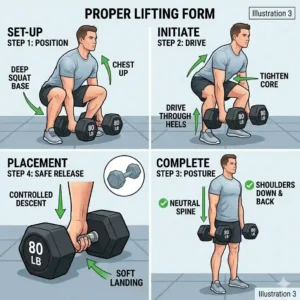
Practical Usage Guide: Taming the 80-Pound Beast
When you upgrade to heavy weights, the rules of engagement change. Here is a practical, step-by-step roadmap for your first 30 days handling 80 lb dumbbells, based on countless hours of coaching.
Step 1: The “Kick-Up” Mastery
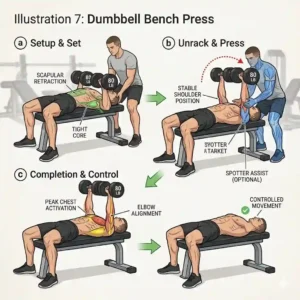
You cannot muscle an 80-pound weight into starting position for a shoulder or chest press without risking a rotator cuff tear. You must master the knee kick-up. Sit on the edge of your bench with the dumbbells resting vertically on your lower thighs. As you fall back onto the bench, aggressively drive your knees upward one at a time to propel the weights into the starting lockout position.
Step 2: Floor Management
If you purchased the CAP Cast Iron or Rogue Rubber Hex, standard yoga mats will not save your floor. Go to a tractor supply store and buy 3/4-inch vulcanized horse stall mats. These are cheap, indestructible, and exactly what we use in commercial facilities to absorb the kinetic energy of an 80-pound free-falling mass.
Step 3: Maintenance Cycle (Year One Roadmap)
-
Month 1: Wipe down urethane or rubber weights with a damp cloth to remove manufacturing oils. For adjustables, practice gently setting them into their cradles.
-
Month 6: If you have iron weights, inspect for chips. Dab exposed metal with a black rust-inhibitor paint. For the PowerBlock, wipe the selector pin with a dry cloth to ensure the magnet stays free of iron dust.
-
Month 12: Check the friction-welds on fixed dumbbells. While rare, heavy dropping can micro-fracture cheaper welds. A slight rattle means it’s time to relegate that bell to non-overhead movements.
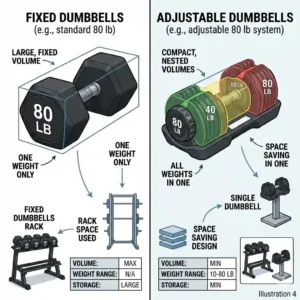
Problem → Solution: Overcoming Grip and Fatigue
Stepping up to 80 lb dumbbells introduces new physiological bottlenecks. Here are the most common issues my clients face, and exactly how to solve them.
Problem: Grip Fails Before the Back Does
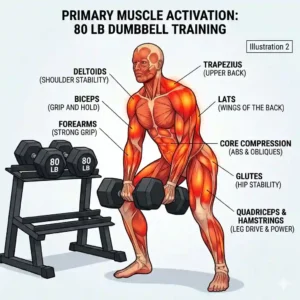
When doing heavy single-arm rows, your latissimus dorsi (back muscle) can often handle the 80 pounds, but your forearm gives out at rep six.
The Solution: Implement lifting straps for pull days. I highly recommend figure-8 straps. They take the load off your flexor tendons, allowing you to fully exhaust the target back muscles. Don’t let grip strength be the limiting factor for back hypertrophy.
Problem: Wrist Pain During Presses
Heavy weights compress the wrist joint, especially on straight handles like the REP Urethane.
The Solution: Use stiff wrist wraps. Wrap them high on the wrist (actually covering the base of the hand) to create a cast-like support. Alternatively, if you use the PowerBlock, allow your wrist to gently rest against the upper rails of the cage to force a neutral wrist alignment.
Problem: Unbalanced Adjustable Weights
Dial-based adjustables can sometimes feel “bottom-heavy” because of the way the plates are selected.
The Solution: Slow down your eccentric (lowering) phase. A 3-second descent forces your stabilizing muscles to adapt to the unique center of gravity of an adjustable dumbbell, turning a perceived negative into a core-stabilization benefit.
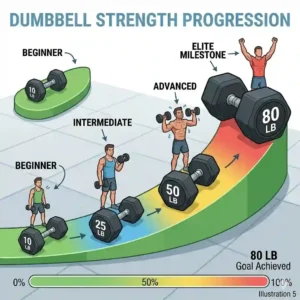
Adjustable vs Fixed 80 lb Dumbbells: The Space/Time Tradeoff
Choosing between fixed or adjustable 80 lb dumbbells isn’t just about money; it’s about analyzing your workout ecosystem.
Fixed dumbbells offer immediate, brainless accessibility. If you are doing a mechanical drop set—say, going from 80s to 60s to 40s on a bench press—fixed weights allow you to simply drop the heavy ones, grab the lighter ones, and continue within 3 seconds. This keeps the muscle under immense metabolic stress.
Adjustables, like the Bowflex 1090, force a 10 to 15-second delay to re-rack and turn the dials. In my field tests, this slight delay allows just enough ATP (adenosine triphosphate) regeneration in the muscle to slightly reduce the effectiveness of a strict, rapid drop-set. However, if your training focuses on straight sets with 2-minute rest periods, that 15-second dial change is completely irrelevant.
The Insider Verdict: If you train in circuits or rapid drop-sets, save up and build a fixed rack. If you do standard straight-set hypertrophy or strength blocks, adjustables will save you a fortune and half a garage’s worth of space.
Urethane vs. Rubber vs. Cast Iron: A Detailed Breakdown
Materials dictate longevity, environmental impact, and cost. Let’s look at the core differences.
| Material | Odor Level | Durability | Shock Absorption | Cost Factor |
| Polyurethane | Zero | Extreme (Tear-proof) | Moderate | $$$$ |
| Heavy Rubber | High (Initially) | High | Excellent | $$ |
| Cast Iron/Enamel | Zero | Low (Chips easily) | Zero | $ |
Looking at the table, Polyurethane represents the apex of dumbbell engineering. According to basic materials science, the cross-linking of polymers in urethane makes it practically impervious to slicing or peeling. Rubber is fantastic for shock absorption (perfect for garage drops), but over years of UV exposure from open garage doors, it will slowly oxidize and crack. Cast iron is for purists who prioritize cost over aesthetics and floor protection.
What to Expect: Real-World Performance at High Weights
The spec sheet says “80 lbs,” but the reality of maneuvering that mass is entirely different.
First, consider the bulk. A fixed 80 lb rubber hex dumbbell is significantly wider than a 40 lb one. When performing a seated dumbbell shoulder press, you will notice that the bells might clink together at the top of the movement sooner than you expect, artificially limiting your terminal range of motion.
I’ve found that adjusting your pressing angle slightly—turning your palms inward about 45 degrees (a neutral-ish grip)—allows the dumbbells to clear each other, giving you a deeper, more natural lockout.
Furthermore, the mental fatigue of handling heavy weights is real. Picking up 80 lb dumbbells requires a bracing sequence. You must take a deep diaphragmatic breath and brace your core before lifting them off the floor or rack. Treating an 80-pounder like a 20-pounder is a fast track to a lumbar sprain.
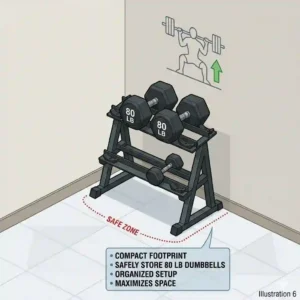
Common Mistakes When Buying Heavy Dumbbells
Over the years, I’ve watched clients waste thousands of dollars by falling into a few predictable traps.
Mistake 1: Ignoring the Handle Diameter
As mentioned, an 80 lb dumbbell on a skinny 28mm handle is torture. The pressure per square inch on your skin is immense. Always look for a handle diameter of 32mm to 35mm once you cross the 70-pound threshold.
Mistake 2: Buying Pinned Dumbbells over Welded
Cheap dumbbells use a steel pin to attach the head to the handle. After 50 drops, that pin bends, and the dumbbell head begins to rattle. It is deeply unsettling to have 80 pounds of iron rattling above your face during a skull-crusher. Always ensure the specs read “friction-welded” or “solid cast” to avoid this.
Mistake 3: Underestimating the Rack Cost
If you buy pairs of fixed dumbbells from 50 to 80 pounds, you cannot leave them on the floor. A heavy-duty, commercial-grade 3-tier rack capable of holding that much concentrated weight will easily cost as much as a pair of the dumbbells themselves. Factor this into your budget immediately.
Long-Term Cost & Floor Impact Analysis
Let’s talk about the Total Cost of Ownership (TCO). Going cheap initially can cost you exponentially more in the long run.
If you purchase the cheapest iron dumbbells, you save money upfront. However, dropping an 80-pound iron weight on standard laminate gym flooring will punch a hole straight through to the subfloor. I have seen clients cause $1,500 in flooring damage to save $40 on dumbbells.
When you buy rubber or urethane, you are inherently buying “floor insurance.” Furthermore, urethane weights have a near-infinite lifespan indoors. If you decide to sell your gym equipment in five years, premium urethane dumbbells retain up to 80% of their retail value on the secondhand market, whereas chipped iron or sun-cracked rubber might fetch 30% on a good day. The high-end option is actually the cheaper long-term investment.
For deeper reading on safe home gym setups, the National Strength and Conditioning Association (NSCA) provides excellent facility guidelines that scale perfectly down to the garage gym level.
Features That Actually Matter (And Those That Don’t)
Marketing hype is rampant in the fitness industry. Let’s filter out the noise.
What DOESN’T Matter: “Anti-Roll” Hex Geometry for Advanced Lifters
Brands heavily market the hex shape as an “anti-roll” safety feature. While true, if your gym floor is so unlevel that an 80-pound round urethane dumbbell rolls away on its own, you have foundation problems, not dumbbell problems. Round dumbbells actually feel much better when resting on your thighs before a set.
What DOES Matter: Knurling Profile
The texture of the handle is everything. You want a “volcano” knurl—where the tips of the diamonds are indented like a crater. This provides massive surface area for friction without piercing the skin. A “mountain” knurl (sharp points) will shred your hands at 80 pounds, and a “passive” knurl will slip when your hands get sweaty during heavy lunges. According to research published in sports biomechanics, grip security directly correlates to central nervous system output; if you feel like you’re going to drop the weight, your brain will artificially limit your muscle recruitment.
✨ Don’t Miss These Exclusive Deals!
🔍 Ready to pull the trigger on your heavy-duty upgrade? Click on any highlighted item above to check current pricing and availability. Make sure to grab some figure-8 lifting straps while you’re at it to maximize those heavy back days!
Conclusion
Transitioning to 80 lb dumbbells is a milestone in any lifter’s career. Whether you choose the indestructible commercial feel of the Rogue Rubber Hex, the premium, zero-odor aesthetics of the REP Urethane, or the brilliant space-saving design of the PowerBlock Pro EXP, your choice should ultimately reflect your training style, available space, and budget.
Remember, these aren’t just weights; they are tools that command respect. Pair them with proper flooring, sensible lifting techniques, and a solid understanding of progressive overload, and they will serve you for a lifetime.
FAQs
❓ Are 80 lb dumbbells considered heavy for a home gym?
✅ Yes, 80 lb dumbbells are considered advanced-level weights. They require substantial foundational strength to maneuver safely and are typically used by experienced lifters for heavy compound movements like chest presses, squats, and rows…
❓ Can I drop adjustable dumbbells if I fail a lift?
✅ Absolutely not. Most adjustable dumbbells feature complex internal dials, plastic selectors, or magnetic pins. Dropping them from bench height will likely shatter the mechanisms, voiding the warranty and ruining the weight…
❓ Which is better for heavy dumbbells: rubber or urethane?
✅ Urethane is vastly superior. It has zero odor, won’t degrade in sunlight, and is highly resistant to tearing and peeling. Rubber is cheaper and offers great shock absorption, but will off-gas a strong smell initially…
❓ How thick should the handle be on an 80 lb dumbbell?
✅ Look for a handle diameter between 32mm and 35mm. Thicker handles distribute the heavy load more evenly across your palm, preventing the bar from cutting into your hand and causing premature grip fatigue…
❓ How do I safely get 80 lb dumbbells into position for a chest press?
✅ Sit on the bench with the weights resting vertically on your knees. As you lie back, simultaneously kick your knees upward, using the momentum to drive the dumbbells into the starting lockout position over your chest…
Recommended for You
- 70 lb Dumbbell Guide: 5 Elite Picks for Unstoppable Gains (2026)
- 5 Best iron dumbbells for Your 2026 Home Gym (Expert Review)
- 5 Best dumbbells 80 lbs for Unstoppable Muscle Growth (2026 Guide)
Disclaimer: This article contains affiliate links. As an Amazon Associate, I earn from qualifying purchases. If you purchase products through these links, we may earn a small commission at no additional cost to you.
✨ Found this helpful? Share it with your friends! 💬🤗
[addtoany]
