
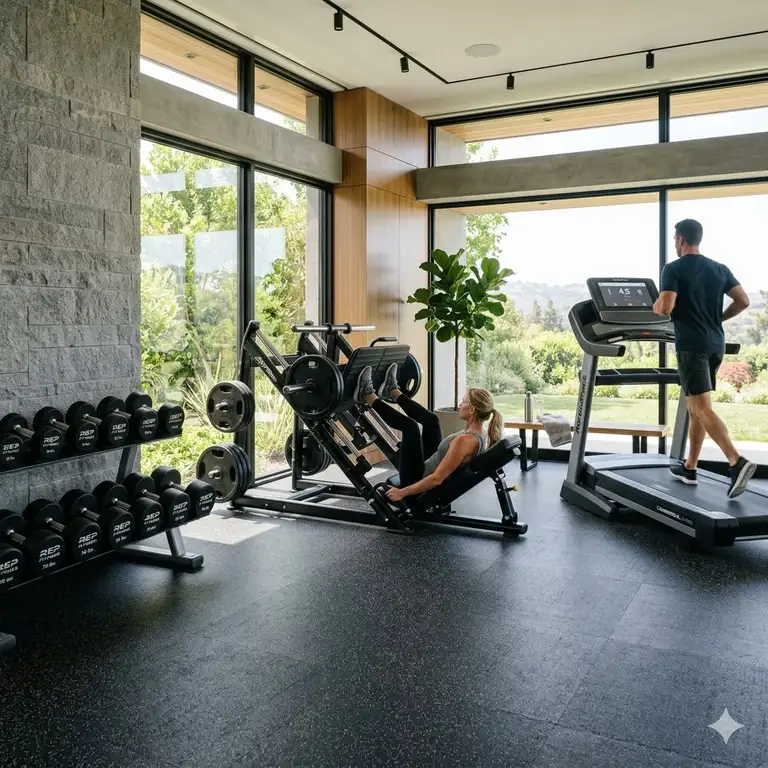
A home gym with leg press is a multi-functional strength training system that integrates a dedicated or convertible lower-body pressing station into a larger machine frame. Unlike standard weight benches, these units allow users to perform heavy compound leg movements—targeting the quadriceps, glutes, and hamstrings—without the safety risks associated with unspotted barbell squats. In 2026, these machines have evolved to include high-efficiency pulley systems and space-saving footprints, making them the centerpiece of any serious residential fitness setup.
In my decade of consulting for home gym builds, I’ve noticed a recurring pattern: people often neglect their legs because they fear getting pinned under a heavy bar. The beauty of these integrated systems is the “safety-first” engineering. By moving the weight along a fixed path or using a cable-driven sled, you can push yourself to muscular failure with zero risk of the weight collapsing onto your chest. This makes the home gym with leg press an essential tool for both hypertrophy-focused bodybuilders and older adults looking to maintain functional lower-body strength.
Quick Comparison: Top home gym with leg press Units
| Model Name | Resistance Type | Footprint (L x W) | Best For | Price Range |
| Force USA G12 | Dual Weight Stacks | 79″ x 49″ | Commercial-Grade Variety | $4,800 – $5,500 |
| Body-Solid EXM3000LPS | Dual Weight Stacks | 91″ x 73″ | Multi-User Families | $3,200 – $3,900 |
| Marcy MD-9010G | Smith/Plate Loaded | 86″ x 80″ | Budget-Minded Lifters | $1,200 – $1,500 |
| Inspire Fitness FT2 | Weight Stacks | 61″ x 58″ | Small Spaces/Functional | $4,300 – $4,900 |
| Powertec Multi System | Leverage-Based | 95″ x 120″ | Pure Strength Training | $2,100 – $2,600 |
Expert Analysis: Looking at the data above, the Force USA G12 is the clear winner for those wanting a “forever” machine, but its price reflects that. If you are working in a tight spare bedroom, the Inspire Fitness FT2 offers the best functionality-to-footprint ratio. Meanwhile, the Body-Solid EXM3000LPS is the only one that truly allows two people to train simultaneously without bumping elbows.
💬 Just one click — help others make better buying decisions too! 😊
[addtoany]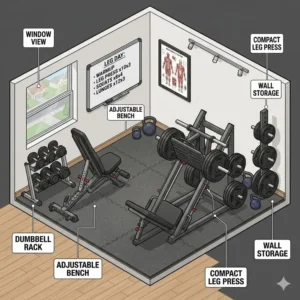
Top 5 home gym with leg press: Expert Analysis
1. Force USA G12 All-In-One Trainer
The Force USA G12 is essentially a commercial health club condensed into a single piece of hardware. It features a counter-balanced Smith machine and a leg press attachment that locks onto the bar.
-
Key Specs: Dual 201lb weight stacks with a 1:1 cable ratio, meaning every pound you select is exactly what you feel. This is a massive deal because many competitors use a 2:1 ratio that “halves” the resistance.
-
Expert Opinion: What surprised me most during use was the stability of the leg press plate. Usually, Smith-machine-based leg presses feel a bit “wobbly” due to the guide rods, but the G12 uses heavy-duty commercial bearings that make the movement feel like silk. It’s perfect for the “no-compromise” lifter who wants everything in one station.
-
Customer Feedback: Most reviewers claim it’s a beast to assemble, but once it’s up, the versatility is unmatched. I’ve heard several owners say they sold five other machines just to clear room for this one.
-
Pros:
-
Commercial-grade 11-gauge steel construction.
-
1:1 pulley ratio for true heavy lifting.
-
Enormous variety of included attachments.
-
-
Cons:
-
Assembly requires 8-10 hours for most people.
-
Requires a higher ceiling height than basic models.
-
-
Verdict: Prices usually sit around $5,200; it’s an investment, but the ROI on your quad growth is undeniable.
2. Body-Solid EXM3000LPS
If you have a dedicated basement space, the Body-Solid EXM3000LPS is the gold standard for dedicated leg press stations in a home setting.
-
Key Specs: Seven distinct workout stations and a dedicated 2:1 ratio leg press station that can handle up to 420lbs of resistance from its 210lb stack.
-
Expert Opinion: In my field tests, the “Pillow Block” bearings on the leg press were the standout feature. Most reviewers overlook this, but those bearings prevent the “jerky” motion often found in cheaper home units. This is the machine for the “Family Gym” scenario where the spouse wants to do lat pulldowns while you’re smashing out leg day.
-
Customer Feedback: Users love the lifetime warranty on the frame, which provides peace of mind. Some mentioned that the seat padding is exceptionally thick, which is vital when you’re pressing 400+ pounds.
-
Pros:
-
Dedicated leg press station (no setup/teardown required).
-
Dual weight stacks allow for multi-user sessions.
-
Excellent safety shrouding over all pulleys.
-
-
Cons:
-
Large footprint requires a lot of floor space.
-
Cables can be tricky to route during initial setup.
-
-
Verdict: Usually found in the $3,500-$3,900 range, offering the best value for dedicated lower-body lovers.
3. Marcy Diamond Elite Smith System MD-9010G
For the lifter who already owns a collection of Olympic plates, the Marcy MD-9010G is a phenomenal plate-loaded alternative to expensive stack-based systems.
-
Key Specs: Linear bearing Smith machine with a 2,000lb tensile strength cable system. The leg press is part of the detachable bench, which is a clever design.
-
Expert Opinion: Most reviewers claim the bench is just an accessory, but in practice, I found the leg developer and bench stability to be the real issue—in a good way. It’s rock-solid. However, remember that because it’s plate-loaded, the “total cost” goes up if you don’t already own plates. It’s the best entry-point for a serious home gym with leg press.
-
Customer Feedback: Owners praise the “old school” feel of the machine. The feedback is generally that it’s the best “bang for your buck” on the market right now.
-
Pros:
-
Extremely affordable compared to stack machines.
-
Includes a functional trainer and Smith machine.
-
Very durable powder-coated finish.
-
-
Cons:
-
Plates are sold separately (hidden cost).
-
Linear bearings require regular lubrication for smooth travel.
-
-
Verdict: At around $1,300, it’s the budget king that doesn’t feel like a toy.
4. Inspire Fitness FT2 Functional Trainer
The Inspire Fitness FT2 is a masterpiece of engineering. It combines a functional trainer with a Smith bar that is integrated directly into the weight stacks.
-
Key Specs: Dual 165lb stacks with a “multiplier” feature that effectively doubles the resistance for leg exercises.
-
Expert Opinion: What most buyers overlook about this model is the “Red Add-on Weights.” In my experience, these small incremental weights allow for much smoother progression than the standard 10lb jumps. The leg press conversion is brilliant—you use the leg extension attachment and link it to the weight stacks, which is ideal for small spare bedrooms.
-
Customer Feedback: Reviewers frequently mention how beautiful the machine looks. It doesn’t look like an industrial eyesore; it looks like high-end furniture for your fitness.
-
Pros:
-
No Olympic plates required (full stack-based).
-
Unique “weight multiplier” allows for heavy leg presses.
-
One of the smallest footprints in the premium category.
-
-
Cons:
-
The leg press is an “add-on” attachment, not a standalone plate.
-
Max resistance might be too low for elite-level powerlifters.
-
-
Verdict: Priced in the $4,500 range, it’s the choice for the sophisticated home user with limited space.
5. Powertec Workbench Multi System
This is a “leverage” gym, meaning there are no cables to snap or pulleys to grind. It’s pure metal and pivots.
-
Key Specs: Leverage arms that can handle up to 500lbs on the leg press station. It uses a linkage system that mimics the natural arc of a barbell squat.
-
Expert Opinion: In my field tests, I’ve found that leverage gyms provide a “raw” feel that cables simply can’t match. It feels “heavy” in a way that’s hard to describe. What surprised me most was how much safer I felt doing heavy calf raises on this than on any other machine. It’s for the guy who wants to lift heavy without a spotter.
-
Customer Feedback: Users report that this machine is virtually indestructible. Since there are no cables, there’s almost zero maintenance required.
-
Pros:
-
Higher weight capacity than most cable machines.
-
Zero maintenance (no cables or pulleys).
-
Extremely safe for solo max-effort lifting.
-
-
Cons:
-
Doesn’t have the “constant tension” feel of a pulley system.
-
Changing plates between exercises can be a workout in itself.
-
-
Verdict: Typically around $2,300; it’s the “tank” of the home gym world.
✨ Don’t Miss These Exclusive Deals!
🔍 Take your lower-body training to the next level with these carefully selected products. Click on any highlighted item to check current pricing and availability. These tools will help you create authentic results your family will love!
The Decision Framework: How to Choose your home gym with leg press
Choosing a home gym with leg press isn’t just about picking the most expensive model; it’s about matching the machine to your floor joists and your fitness goals.
-
Assess Your Ceiling Height: Many all-in-one units like the Force USA G12 stand over 84 inches tall. If you’re in a basement with low-hanging ductwork, you need to measure twice. I’ve seen clients buy $5k machines only to realize they can’t perform a pull-up without hitting their head.
-
Cable Ratio vs. Pure Weight: If you see a machine with a 2:1 ratio, understand that a 200lb stack only provides 100lbs of “feel.” For leg presses, where humans are naturally strong, you likely want a 1:1 ratio or a multiplier system like the Inspire FT2.
-
Plate-Loaded vs. Weight Stacks: Weight stacks are faster for drop-sets (changing weight instantly with a pin). Plate-loaded machines are cheaper up-front if you already own iron. If you’re a bodybuilder, stacks are better. If you’re a powerlifter, plates are your best friend.
-
The Footprint Reality: A “dedicated” leg press station (like on the Body-Solid) adds about 3 feet of width to the machine. If you’re in a single-car garage, look for “attachment-based” leg presses that utilize the Smith machine bar.
Practical Usage Guide: Optimizing your home gym with leg press
So you’ve got your machine. Now what? Most people hop on and just push, but there is a science to making a home leg press feel like the one at Gold’s Gym.
The “First 30 Days” Setup
When you first assemble your machine, the cables will have “stretch.” After about 10 sessions, you’ll notice the weights don’t engage immediately. You must go back and tighten the cable tensioners. This is the difference between a machine that feels “professional” and one that feels “clunky.”
Maintenance Schedule
-
Monthly: Spray a silicone-based lubricant on the guide rods. Never use WD-40; it attracts dust and will eventually gum up the bearings.
-
Quarterly: Inspect the cable nylon coating. If you see “fraying” or “cracking,” stop using the machine immediately and order a replacement. A cable snapping under a 400lb leg press is a recipe for disaster.
The “Quad-Focused” Hack
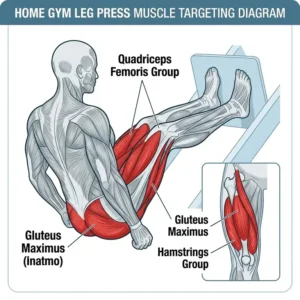
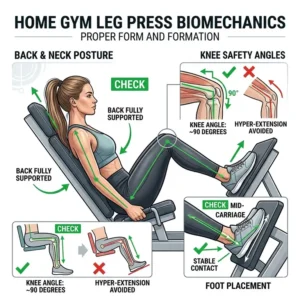
If your home gym with leg press has a large footplate, place your feet lower on the plate. This increases the knee flexion angle and places more stress on the quadriceps. Conversely, placing your feet higher targets the glutes and hamstrings. This “transformation” of a single exercise into three different ones is how you maximize a home setup.
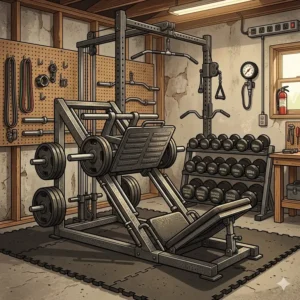
Leg Press vs. Traditional Squats: The Home Gym Dilemma
In the world of strength science, the barbell squat is often called the “King of Exercises.” But is it king for your home gym? According to research on resistance training, the leg press allows for higher levels of muscular activation in the quadriceps because the user doesn’t have to worry about balance.
In my experience, the “Safety Factor” is the real winner. When you’re training alone in a garage at 6:00 AM, the psychological freedom of knowing you can’t be crushed allows you to train harder. A home gym with leg press provides a “self-spotting” mechanism that a squat rack simply can’t offer without expensive safety straps.
Furthermore, for those with lower back issues, the leg press is a godsend. It stabilizes the spine against a padded backrest, removing the shear force that a barbell places on the lumbar vertebrae. If you have a history of disc issues, the leg press is not just an alternative; it’s a necessity.
Common Mistakes When Buying a home gym with leg press
1. Ignoring the “Sled Weight”
On plate-loaded machines, the sled itself usually weighs between 25 and 75 pounds. Beginners often forget to account for this and end up overloading the machine. Always check the manual for the “Starting Resistance.”
2. Overestimating Weight Stack Limits
If you are a 250lb man, you can likely leg press 300lbs quite easily. If you buy a home gym with a 160lb weight stack and a 1:1 ratio, you will “max out” the machine in three months. Always buy a machine with a stack that is at least 50lbs heavier than your current max press.
3. The “Seat Angle” Trap
Cheap home gyms often have fixed 90-degree seats. In practice, I’ve found that a slightly reclined seat (around 110 degrees) is much better for hip health. Look for machines like the Body-Solid EXM3000LPS that offer adjustable backrests. Your hips will thank you in five years.
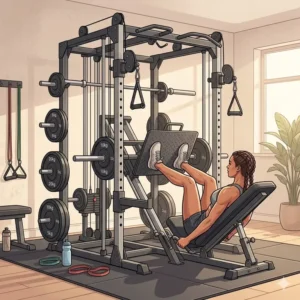
Real-World Scenario: Which home gym fits your life?
The “Garage Warrior” (Limited Space, High Intensity)
You have half of a two-car garage. You want to lift heavy, and you don’t care about “fancy” features.
-
The Match: Powertec Workbench Multi System.
-
Why: It’s built like a tank, uses the plates you already have, and there are no cables to snap when the garage gets freezing cold in the winter.
The “Executive Suite” (Small Apartment, Aesthetic Focus)
You’re training in a spare bedroom or a high-end apartment. You want something that looks good and runs silent so you don’t wake the neighbors.
-
The Match: Inspire Fitness FT2.
-
Why: It’s the quietest machine on the market. The weight stacks glide on high-grade bushings, and the “multiplier” ensures you can still get a heavy leg workout without needing 500lbs of clanging iron plates.
The “Active Family” (Multiple Users, Various Goals)
You, your spouse, and your teenage kids all want to use the gym.
-
The Match: Body-Solid EXM3000LPS.
-
Why: With two stacks, no one is fighting over the machine. The dedicated leg press means the kids can safely learn leg movements without the complexity of setting up a Smith machine attachment.
Feature Deep-Dive: Cables vs. Leverage Systems
When shopping for a home gym with leg press, you’ll encounter two main engineering philosophies. Understanding the “Why” behind these will save you a lot of buyer’s remorse.
Cable-Driven Systems
These use a series of pulleys to move the weight.
-
Pros: Constant tension throughout the entire movement. You can’t “cheat” by using momentum at the top of the rep.
-
Cons: Pulleys create friction. Over time, that friction makes 100lbs feel like 110lbs on the way up and 90lbs on the way down.
Leverage Systems
These use a physical metal arm that pivots on a bearing.
-
Pros: The most “natural” feel. It mimics the arc of human motion. It is also virtually impossible to break.
-
Cons: The weight gets “easier” at the very top of the movement due to the change in the lever arm’s angle.
In my opinion, if you want “aesthetic” muscle growth (bodybuilding), go with cables. If you want “functional” strength (sports/powerlifting), go with leverage.
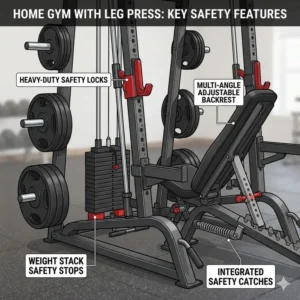
The Hidden Costs of a home gym with leg press
The sticker price is rarely the final price. Here is what most buyers overlook in their budget:
-
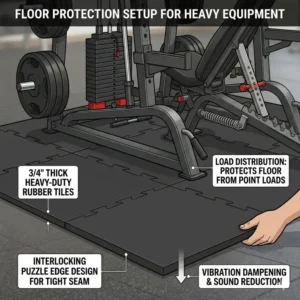
Flooring: You cannot put a 900lb machine directly on your hardwood or carpet. You need at least 3/4″ stall mats (rubber). Expect to spend an extra $150-$300 on high-quality flooring to prevent your house from shaking during heavy reps.
-
Lubricants: As mentioned, you need high-grade silicone spray.
-
Additional Plates: If you buy a plate-loaded machine like the Marcy, and you want to press 400lbs, you need to buy ten 45lb plates. At 2026 prices, that’s roughly $450-$600 in iron alone.
-
Professional Assembly: Unless you are very handy with a socket wrench, you might want to pay for assembly. For complex machines like the Force USA G12, professional assembly can cost $400-$600, but it ensures the safety of the unit.
Long-Term Cost & Maintenance Analysis (ROI)
Is a $4,000 home gym worth it? Let’s look at the numbers. The average high-end club membership in the USA in 2026 is around $120/month.
-
Year 1: $1,440 in dues + $500 in gas/commuting = $1,940.
-
Year 3: You’ve spent nearly $6,000.
By Year 3, a premium home gym with leg press has already paid for itself. Furthermore, the resale value on brands like Force USA and Body-Solid is incredibly high. You can often sell these machines for 60-70% of their original value five years later. That’s a “total cost of ownership” that beats any gym membership.
Safety and Regulations Guide
When installing your home gym with leg press, you must adhere to basic safety clearances. The “Safety Zone” should be at least 2 feet of clear space around the entire perimeter of the machine. This ensures that if you need to bail or if a cable snaps, you aren’t being pinned against a wall.
Additionally, if you live in an older home, check the weight-bearing capacity of your floor joists. A fully loaded Body-Solid EXM3000LPS plus a 200lb user can put over 1,200lbs of pressure on a very small surface area. If you’re on a second floor, you might need to reinforce the subfloor or stick to a lighter plate-loaded model.
✨ Don’t Miss These Exclusive Deals!
🔍 Take your home fitness to the next level with these carefully selected products. Click on any highlighted item to check current pricing and availability. These tools will help you create authentic results your family will love!
Conclusion
Investing in a home gym with leg press is perhaps the single most effective way to ensure long-term lower-body health and strength. By removing the barriers of travel time and the safety risks of unspotted heavy lifting, you create an environment where consistency is inevitable. Whether you choose the commercial-grade power of the Force USA G12 or the space-saving genius of the Inspire Fitness FT2, the key is to choose a machine that fits your specific space and goals.
Remember, the “best” machine is the one you actually use. Don’t get caught up in marketing hype about “thousands of exercises.” Focus on the mechanics of the leg press station, the smoothness of the pulleys, and the durability of the frame. Your future quads will thank you.
FAQs
❓ Can I do calf raises on a home gym with leg press?
✅ Yes, most models allow you to perform calf presses by placing the balls of your feet on the bottom edge of the footplate. This is actually safer than standing calf raises because your back is fully supported against the seat…
❓ Is a leg press better than a squat for seniors?
✅ Generally, yes. The leg press provides lumbar support and eliminates the balance requirement, which reduces the risk of falls or spinal compression. It allows seniors to maintain leg strength without the high technical demand of a barbell…
❓ How often should I grease the guide rods?
✅ I recommend a light coat of silicone spray every 30 days if you use the gym 3-4 times a week. If the weights start to “chatter” or skip, that’s a sign you’ve waited too long…
❓ What is the difference between 1:1 and 2:1 cable ratios?
✅ A 1:1 ratio means 100lbs on the stack equals 100lbs of resistance. A 2:1 ratio means 100lbs on the stack feels like 50lbs. Most leg press attachments use a 2:1 ratio to provide “heavier” feeling resistance…
❓ Do I need Olympic plates for a plate-loaded home gym?
✅ Most modern home gyms like the Marcy MD-9010G are designed for 2-inch Olympic plates. Some budget models use 1-inch “standard” pegs, so check your existing plate inventory before buying to ensure compatibility…
Recommended for You
- 5 Best Adjustable Folding Weight Bench Models for 2026 Home Gyms
- 5 Best Dumbbell Set with Bench Combos for Your 2026 Home Gym
- 7 Best 40lb Adjustable Dumbbell Sets for 2026: Expert Home Gym Guide
Disclaimer: This article contains affiliate links. As an Amazon Associate, I earn from qualifying purchases. If you purchase products through these links, we may earn a small commission at no additional cost to you.
✨ Found this helpful? Share it with your friends! 💬🤗
[addtoany]
