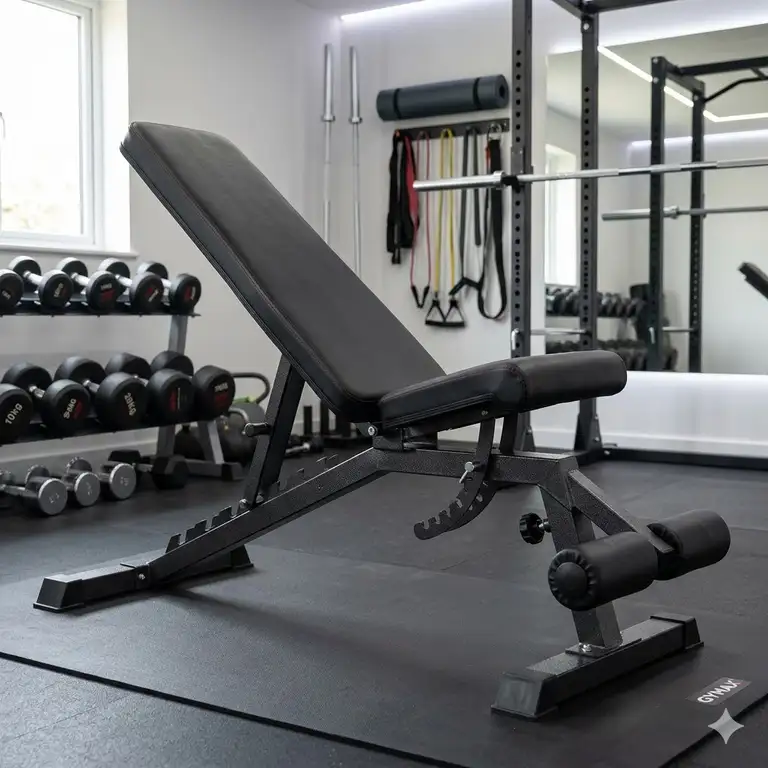
When you walk into a commercial gym, you see rows of equipment, but the humble weight bench decline station is often the one where the most impressive chest transformations happen. A weight bench decline is a specialized piece of strength training equipment designed to position your torso at a downward angle, typically between $15^\circ$ and $30^\circ$ below parallel. This specific orientation shifts the focus of your lifts—most notably the bench press—toward the pectoralis major (lower chest) and reduces the strain on your anterior deltoids and rotator cuffs.
In 2026, the home fitness market has matured significantly. We are no longer just looking for a piece of steel to lie on; we are looking for ergonomic support, space-saving designs, and rock-solid stability. If you have ever felt like your chest development has plateaued or your shoulders scream every time you do flat bench, transitioning to a decline position might be the tactical shift your routine needs. In this guide, I will break down the absolute best options available on Amazon today, providing you with the technical analysis you need to make an informed decision without the marketing fluff.
Quick Comparison: Top weight bench decline Models
| Product Name | Weight Capacity | Adjustability Levels | Best For | Price Range |
| FLYBIRD FB149 | 800 lbs | 7 Back, 3 Seat | All-around Versatility | $130 – $160 |
| Bowflex 5.1S | 600 lbs | 6 Positions | Space-Saving / Quality | $290 – $340 |
| PASYOU PA300 | 500 lbs | 7 Positions | Budget-Conscious | $90 – $115 |
| Fitness Reality 810XLT | 800 lbs | 12+ Combinations | Heavy Lifters | $145 – $185 |
| Steelbody Deluxe | 800 lbs | 6 Positions | Commercial Feel | $210 – $260 |
Expert Analysis: Looking at the data above, the FLYBIRD FB149 offers the most balanced “strength-to-price” ratio for most home users. However, if you are working in a cramped studio apartment, the Bowflex 5.1S justifies its higher price point through its unique vertical stowage feature. For those just starting out and lifting lighter loads, the PASYOU PA300 provides sufficient stability without breaking the $120 barrier.
💬 Just one click — help others make better buying decisions too! 😊
[addtoany]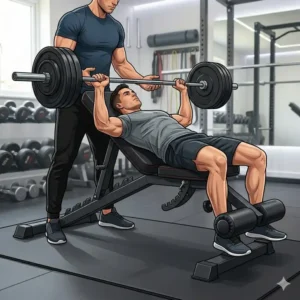
Top 5 weight bench decline Models: Expert Analysis
1. FLYBIRD Adjustable Bench FB149 — The Gold Standard for Home Gyms
The FLYBIRD Adjustable Bench FB149 is widely considered the “workhorse” of the home fitness world. It features a heavy-duty triangular steel frame that provides a maximum weight capacity of 800 lbs. What this means for you in the real world is that the bench won’t “creak” or “rock” when you are repping out heavy dumbbells in a decline position.
In my experience, the most important feature here is the 2-inch thick high-density foam padding. Many cheaper benches use soft foam that bottoms out, but this model maintains its shape, protecting your spine during heavy eccentric movements. The leg lockdown bar is wrapped in comfortable foam, which is critical during a weight bench decline workout because it prevents you from sliding off the bench when gravity is working against you.
-
Customer Feedback: Users consistently praise the “out-of-the-box” readiness, as it comes 95% pre-assembled. Some mention the seat gap is noticeable but doesn’t hinder performance.
-
Expert Opinion: This is the best choice for the “80% user”—someone who lifts regularly, wants stability, but doesn’t need a $1,000 commercial rig.
-
Pros:
-
Fast adjustment with a simple pull-bolt system.
-
Folds down to almost nothing for storage under a bed.
-
Extremely stable triangular design.
-
-
Cons:
-
The gap between seat and backrest can be annoying for taller users.
-
Vinyl cover can get slippery if you sweat heavily.
-
-
Price Range: Typically found around $145.
2. Bowflex 5.1S Stowable Bench — Premium Engineering Meets Space Efficiency
The Bowflex 5.1S Stowable Bench is for the lifter who values engineering and aesthetics as much as the workout itself. Its standout feature is the “Click-Lift” adjustment system, which allows you to move from a $-20^\circ$ decline to a $90^\circ$ incline in seconds. The 600 lb capacity is lower than some competitors, but the build quality feels significantly more “premium.”
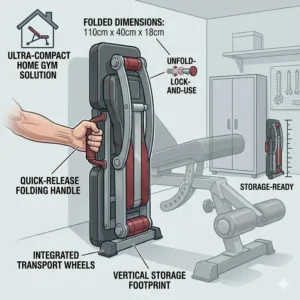
What most buyers overlook is the footprint reduction. This bench reduces its footprint by more than 50% when stowed vertically. If your gym is also your home office, this is a lifesaver. The wide leveling feet ensure that even on slightly uneven garage floors, you stay balanced. According to the Centers for Disease Control and Prevention (CDC), muscle-strengthening activities are vital for long-term health, and having a bench that doesn’t annoy you with its size makes you more likely to actually use it.
-
Customer Feedback: Reviewers love the “sturdiness” and the red-on-black aesthetic. Some noted that it is heavier to move than cheaper aluminum models.
-
Expert Opinion: Choose this if you have the budget and need a bench that looks good and stays out of the way when not in use.
-
Pros:
-
Superior vertical storage design.
-
Excellent leg hold-down bar for decline security.
-
Highly durable, professional-grade upholstery.
-
-
Cons:
-
Higher price point than most “Amazon specials.”
-
Slightly lower weight capacity than some heavy-duty steel competitors.
-
-
Price Range: Generally in the $300-$330 range.
3. PASYOU Adjustable Weight Bench PA300 — The Best Entry-Level Value
The PASYOU Adjustable Weight Bench PA300 is the perfect entry point for those building their first home gym on a budget. Don’t let the “budget” tag fool you; it still offers a 500 lb weight capacity and 7 backrest positions. In practice, 500 lbs is more than enough for 90% of home lifters who are using dumbbells or a standard barbell set.
The powder-coated finish is surprisingly resilient against sweat-induced corrosion. However, the padding is slightly thinner than the FLYBIRD. I recommend this model for people focusing on abdominal work or lighter chest flys where the absolute maximum rigidity isn’t as vital as it would be for a 300 lb bench press. It’s a fantastic way to introduce a weight bench decline into your routine without a massive financial commitment.
-
Customer Feedback: Most users are shocked by the quality given the price, though some mention the assembly instructions could be clearer.
-
Expert Opinion: This is the “no-excuses” bench. It does exactly what it says it will do for a very fair price.
-
Pros:
-
Extremely affordable for those on a strict budget.
-
Very lightweight and easy to move around.
-
Simple, intuitive adjustment ladder.
-
-
Cons:
-
Not suitable for elite-level powerlifting.
-
The foam on the leg rollers is a bit thin for heavy decline work.
-
-
Price Range: Around $100.
4. Fitness Reality 810XLT Super Max — The Heavy Duty Contender
The Fitness Reality 810XLT Super Max is built for the “power user.” With an 800 lb weight capacity and an extra-wide backrest, this bench feels like it belongs in a high-end CrossFit box. The frame is constructed from 2″ x 3″ steel tubing, which is significantly thicker than the standard 2″ x 2″ found on budget models.
In my experience, the wider backrest (12 inches) is the game-changer here. It provides much better scapular support during decline presses. If you’ve ever felt like your shoulders were “hanging off” a narrow bench, this model solves that problem. It also pairs perfectly with the Fitness Reality Power Cage, making it a central piece of a full-scale home gym setup.
-
Customer Feedback: Users rave about the “tank-like” build quality. A few users mentioned that the bench is a bit tall, which might be a struggle for lifters under 5’5″.
-
Expert Opinion: If you plan on lifting heavy and want a bench that will last a decade, this is the one to buy.
-
Pros:
-
Massive 800 lb weight capacity.
-
Wide backrest for better stability and comfort.
-
Extended leg lockdown for secure decline positioning.
-
-
Cons:
-
Heavier and harder to move than “foldable” models.
-
Slightly higher seat height may be uncomfortable for shorter individuals.
-
-
Price Range: Around $160-$180.
5. Steelbody Deluxe Versatile Utility Bench — The Commercial Grade Experience
The Steelbody Deluxe Versatile Utility Bench brings the feel of a commercial gym into your garage. It uses a high-grade powder coating and thick, box-stitched upholstery that resists tears and punctures. While many benches use simple plastic end caps, the Steelbody uses reinforced steel joints, which significantly reduces the “side-to-side” wobble common in home equipment.
What I find impressive about this model is the “friction-less” adjustment track. It doesn’t use the standard pins that get stuck; instead, it uses a smooth sliding mechanism. For decline work, it offers a very secure angle that feels locked in. It’s a “buy it once” kind of product. According to research on Weight Training, equipment stability is a primary factor in preventing acute injury, and the Steelbody excels here.
-
Customer Feedback: Most buyers note that it “feels much more expensive than it is.” Some noted it takes about 45 minutes to assemble properly.
-
Expert Opinion: Perfect for the aesthetics-focused lifter who wants their home gym to look and feel professional.
-
Pros:
-
Commercial-grade materials and build quality.
-
Extra-thick padding with reinforced stitching.
-
Large transport wheels make moving it a breeze.
-
-
Cons:
-
Does not fold for storage (requires dedicated space).
-
Assembly is more complex than other models.
-
-
Price Range: Typically around $230.
✨ Don’t Miss These Exclusive Deals!
🔍 Take your chest workouts to the next level with these carefully selected products. Click on any highlighted item to check current pricing and availability. These tools will help you create authentic results your family will love!
Mastering the Setup: A 30-Day Guide to Longevity
Buying a weight bench decline is only the first step; maintaining it ensures your safety and protects your investment. Most people build their bench, use it for a month, and then wonder why it starts to squeak. Here is a professional maintenance and setup schedule.
Step-by-Step Setup Tips
-
The “Hand-Tight” Rule: When assembling, never fully tighten bolts until the entire frame is together. This allows the steel to “settle,” preventing a crooked bench.
-
Leveling the Playing Field: Most garage floors have a slight slope for drainage. Use the leveling feet on models like the Bowflex 5.1S to ensure your bench is perfectly horizontal. A $1^\circ$ tilt might not seem like much, but under a 200 lb load, it creates uneven torque on your spine.
-
Vinyl Conditioning: Use a UV-protectant spray (like those used for car interiors) on the vinyl padding once a month. This prevents sweat from drying out the material and causing “cracking.”
Optimization Tricks for Better Performance
-
The Chalk Trick: If your bench vinyl is slippery, don’t use more towels. A light dusting of lifting chalk on the backrest can provide the “grip” your shoulder blades need to stay retracted during a heavy press.
-
Bolt Check Schedule: Every 30 days, take a wrench to the main pivot bolts. Dynamic movements (like jumping on/off the bench) cause microscopic vibrations that loosen nuts over time. A 5-minute check could prevent a structural failure.
The Decline Decision: Which User Profile Are You?
Choosing a weight bench decline depends heavily on your lifestyle and fitness goals. Using a “one size fits all” approach often leads to buyer’s remorse. Let’s look at three common scenarios.
Profile A: The “Apartment Dweller”
You have limited space and perhaps a roommate who doesn’t want a “gym smell” in the living room.
-
Recommendation: Bowflex 5.1S.
-
Reasoning: Its ability to stand vertically in a corner is unmatched. You can finish your workout, wipe it down, and hide it behind a door in 30 seconds.
Profile B: The “Garage Powerlifter”
You have a dedicated space and your goal is purely moving the most weight possible. You don’t care about folding; you care about not dying under a barbell.
-
Recommendation: Fitness Reality 810XLT.
-
Reasoning: The 800 lb capacity and wide backrest provide the structural integrity required for heavy compounds. It’s a “set it and forget it” piece of hardware.
Profile C: The “HIIT & Core Enthusiast”
You use the bench for more than just pressing. You do decline sit-ups, step-ups, and light dumbbell work.
-
Recommendation: FLYBIRD FB149.
-
Reasoning: Its versatility is its strength. It’s light enough to move quickly during a circuit but sturdy enough to handle the dynamic force of a decline crunch.
How to Choose the Perfect weight bench decline Model
Choosing a bench isn’t just about the price tag. You need to evaluate the mechanical specs against your physical needs. Follow these five steps to find your match:
-
Check the Static vs. Dynamic Load: A bench rated for 800 lbs usually refers to static weight. If you weigh 200 lbs and are lifting 200 lbs, you are putting 400 lbs of dynamic force on the frame. Always aim for a capacity at least 2x your total expected weight.
-
Measure the Seat Height: For decline work, you want your feet securely locked. If the seat is too high (above 18 inches), your legs might struggle to reach the rollers comfortably, compromising your arch.
-
Evaluate the “Gap”: All adjustable benches have a gap between the seat and back. Look for models where this gap is less than 2 inches, or where the seat angle can be adjusted to close the distance.
-
Inspect the Footprint: Measure your workout area. Remember to add 2 feet of clearance on all sides so you can safely mount and dismount the bench.
-
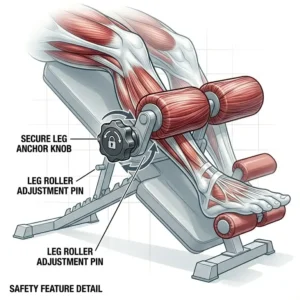
Look for Leg Rollers: A weight bench decline is useless without secure leg rollers. Ensure they are covered in high-density foam (at least 3-inch diameter) to prevent bruising on your shins during heavy sets.
Decline vs. Flat: The Hidden Science of Muscle Recruitment
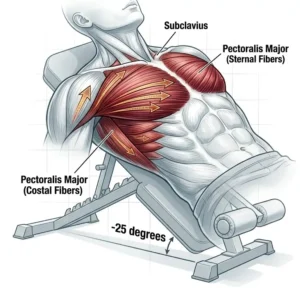
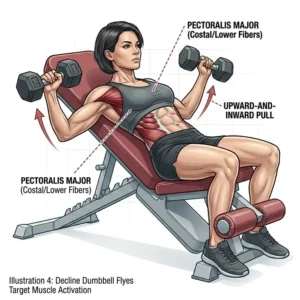
Why bother with a weight bench decline at all? The answer lies in physics and biomechanics. When you lie flat, the force of gravity acts perpendicularly to your torso. When you shift to a decline, you change the “line of pull” for your muscle fibers.
The lower portion of the pectoralis major (the abdominal head) is most active when the arm is brought down toward the hips. A decline angle of roughly $-15^\circ$ to $-30^\circ$ aligns the resistance perfectly with these fibers. Scientific studies often show that the decline press allows for higher weight loads because the range of motion is slightly shorter and the mechanical advantage is greater.
Mathematically, the force required to move the weight can be viewed through the lens of the angle $\theta$:
$$F_{\text{effective}} = m \cdot g \cdot \cos(\theta)$$
By altering $\theta$, you are essentially changing how your body perceives the load, often allowing you to push past plateaus that have kept you stuck on the flat bench for months.
Safety First: Preventing “Head-First” Disasters
Working out in a decline position presents unique safety challenges. Because your head is lower than your heart, blood pressure in the skull increases (intraocular pressure).
-
Avoid Over-Duration: Never stay in the decline position for more than 60-90 seconds at a time. Sit up between sets to allow your blood flow to normalize.
-
The Spotter Rule: If you are using a barbell on a weight bench decline, a spotter is non-negotiable. Unlike a flat bench where you can “roll of shame” the bar down to your hips, in a decline, the bar naturally wants to move toward your neck/face if you fail a rep.
-
Secure the Rollers: Always test the leg lockdown before you pick up your weights. If your feet slip while you have two 80-lb dumbbells over your chest, the result could be catastrophic.
Features That Actually Matter (And Those That Don’t)
Marketing departments love to talk about “NASA-grade steel” or “bionic upholstery.” Let’s filter the noise.
What Matters:
-
Steel Gauge: Look for 12 or 14-gauge steel. Anything higher (like 16 or 18) is thinner and will flex under load.
-
Transport Wheels: A 60-lb bench is awkward to carry. Wheels make a world of difference.
-
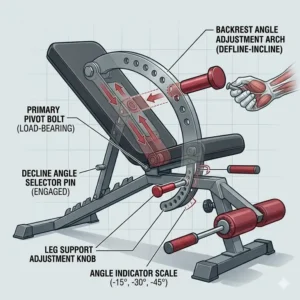
Locking Pins: Spring-loaded pull-pins are much faster and safer than manual screw-in knobs.
What Doesn’t Matter:
-
Color Schemes: Unless you’re an influencer, the “cool” lime green accents won’t add an inch to your chest.
-
Brand Names on the Vinyl: You’re paying for the logo, not the support. Focus on the foam density instead.
-
Included “Exercise Posters”: You can find better routines on YouTube in 5 seconds. Don’t pay extra for a piece of glossy paper.
Maxing Your ROI: Total Cost of Home Gym Ownership
When you buy a weight bench decline for around $150, you aren’t just spending money; you’re saving it. Let’s look at the ROI over a 5-year period.
| Expense Type | Commercial Gym | Home Gym (Bench + DBs) |
| Monthly Fee | $50 | $0 |
| Commute (Gas/Time) | $20 | $0 |
| Initial Investment | $0 | $600 |
| 5-Year Total | $4,200 | $600 |
Analysis: The math is clear. Even if you buy a premium bench like the Steelbody Deluxe, you break even against a standard gym membership in less than 6 months. Furthermore, quality gym equipment has a high resale value. A well-maintained FLYBIRD or Bowflex bench typically retains 50-60% of its value on the secondary market, making the actual “cost of use” pennies per day.
✨ Don’t Miss These Exclusive Deals!
🔍 Take your weight bench decline training to the next level with these carefully selected products. Click on any highlighted item to check current pricing and availability.
Conclusion
Investing in a weight bench decline is one of the smartest moves you can make for your home gym in 2026. Whether you choose the space-saving brilliance of the Bowflex 5.1S, the tank-like durability of the Fitness Reality 810XLT, or the incredible value of the FLYBIRD FB149, you are giving yourself the tools to target muscle groups that a standard flat bench simply cannot reach. By following a consistent maintenance schedule and prioritizing safety through proper leg lockdown, your bench will provide years of reliable service.
Remember, the “best” bench is the one that fits your space, matches your lifting style, and—most importantly—actually gets used. Now, take these insights, pick the model that fits your profile, and start building that lower chest definition you’ve been chasing!
FAQs
❓ Is a weight bench decline better than a flat bench?
✅ Neither is “better,” but they serve different purposes. The decline version is superior for targeting the lower chest and reducing shoulder strain. Most experts recommend a mix of both for a well-rounded, symmetrical physique…
❓ What angle should I use for decline exercises?
✅ An angle between $-15^\circ$ and $-30^\circ$ is ideal. Going steeper than $-30^\circ$ often leads to excessive blood rushing to the head and makes it harder to stay positioned properly on the bench rollers…
❓ Can I use a weight bench decline for ab workouts?
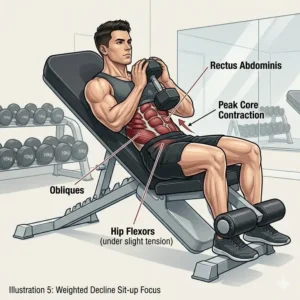
✅ Absolutely. One of the best uses for this equipment is the decline sit-up or Russian twist. The downward angle increases the lever arm of your torso, making standard abdominal exercises significantly more challenging and effective…
❓ How much weight can a standard home bench hold?
✅ Most entry-level benches are rated for 300-500 lbs, while heavy-duty models like the Fitness Reality 810XLT handle up to 800 lbs. Always check the manufacturer’s “Total Weight Capacity,” which includes your body weight…
❓ Is assembly difficult for home weight benches?
✅ Most modern benches, like the FLYBIRD FB149, come 90-95% pre-assembled and take 5-10 minutes. More robust, commercial-style benches may take 45-60 minutes and require basic tools like a socket wrench or adjustable spanner…
Recommended for You
- 5 Best incline adjustable bench Picks for 2026: Expert Guide & Reviews
- 5 Best Dumbbell Set with Bench Combos for Your 2026 Home Gym
- 7 Best 90 lbs dumbbells for Serious Muscle Gains in 2026
Disclaimer: This article contains affiliate links. As an Amazon Associate, I earn from qualifying purchases. If you purchase products through these links, we may earn a small commission at no additional cost to you.
✨ Found this helpful? Share it with your friends! 💬🤗
[addtoany]
