In my 10+ years as a home gym consultant and fitness equipment tester, I’ve seen countless fitness enthusiasts make the same critical mistake: buying loose weights, tossing them in a corner, and hoping for the best. Fast forward three months, and their workout space looks like a hazard zone, completely destroying their motivation to train.
Investing in a proper dumbbell weight rack with weights isn’t just about aesthetics; it’s about biomechanics, safety, and psychological readiness. When your equipment is organized, accessible, and off the floor, your barrier to starting a workout drops to zero.
What is a dumbbell weight rack with weights?
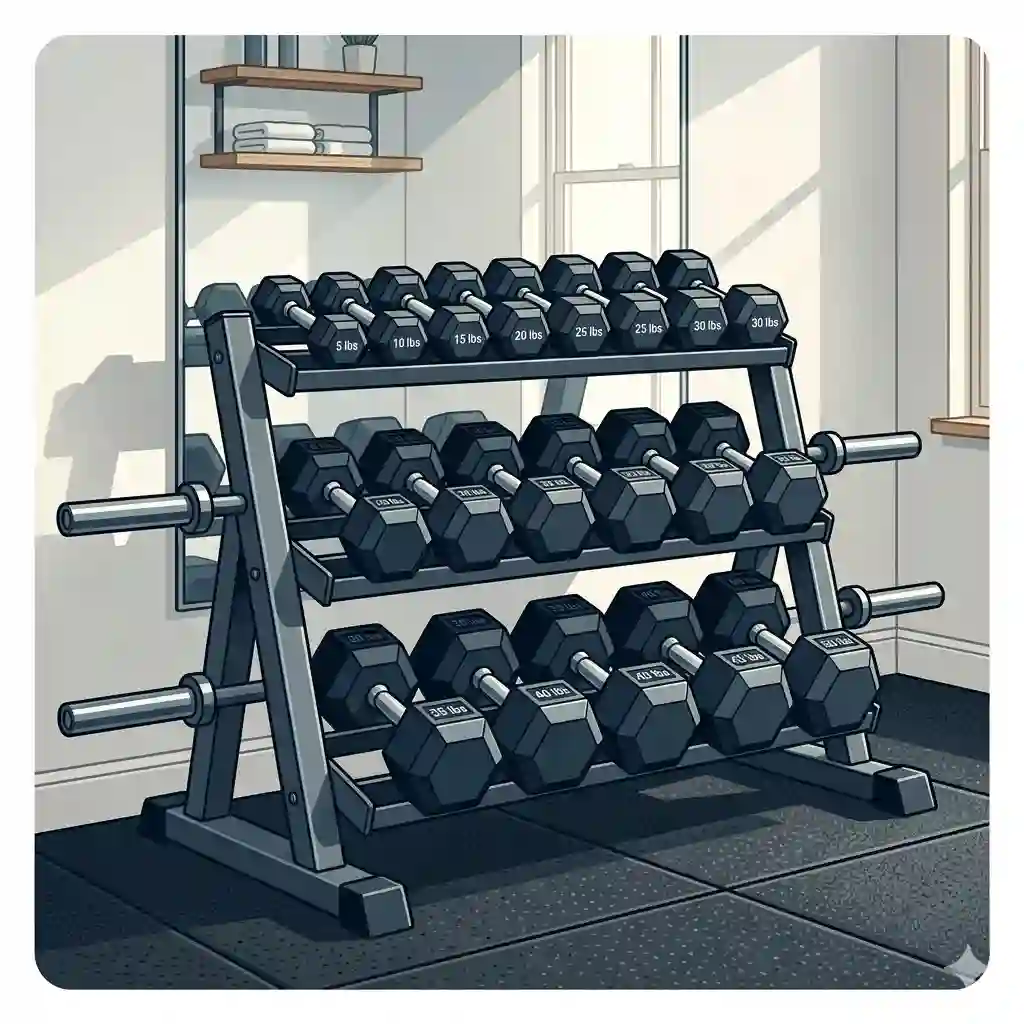
It is a bundled home gym solution consisting of a tiered, A-frame, or vertical storage stand specifically engineered to hold an included set of matched dumbbells (typically ranging from 5 to 50 pounds). This combination ensures the storage unit can safely support the exact load and dimensions of the provided weights without tipping or sagging.
The spec sheets will tout weight capacities and steel gauges, but the reality of daily use is far more nuanced. You need to consider knurling depth, rubber off-gassing, and how easily you can rerack a 40-pound weight when your forearms are completely fried. Throughout this guide, I’ll share the insider insights and hard truths I’ve learned from dropping, dragging, and assembling dozens of these sets. Whether you are building a boutique garage gym or carving out a corner in your living room, finding the perfect dumbbell weight rack with weights is the single highest-ROI decision you can make for your fitness journey.
Quick Comparison: Top Sets at a Glance
Before we dive into the granular details, here is a high-level overview of the top performers from my 2026 field tests.
| Model | Rack Style | Weight Range | Best For | Price Tier |
| CAP Barbell 150-lb Hex Set | A-Frame | 5 – 25 lbs | Budget/Beginners | Under $250 |
| REP Fitness Rubber Hex Set | Tiered Horizontal | 5 – 50 lbs | Serious Lifters | $700 – $900 |
| Rogue Fitness Urethane Set | 2-Tier Heavy Duty | 5 – 50 lbs | Commercial Feel | Premium ($1k+) |
| Bowflex SelectTech 552 | Media Stand | 5 – 52.5 lbs (Adj.) | Small Spaces | $350 – $450 |
| Epic Fitness Neoprene Set | Vertical Tower | 3 – 12 lbs | Rehab/Cardio | Under $100 |
Expert Analysis: Looking at the comparison above, the REP Fitness set delivers the absolute best value in the mid-to-high tier, offering gym-quality rubber hexes that won’t degrade over time. However, if floor space is your absolute strictest constraint, the Bowflex adjustable system justifies its complex mechanism by replacing 15 sets of dumbbells entirely. Budget buyers should note that the CAP Barbell A-frame sacrifices heavier weight increments for its lower price point, making it ideal for beginners but a potential bottleneck for advanced lifters.
💬 Just one click — help others make better buying decisions too! 😊
[addtoany]
Top 5 Picks: In-Depth Review and Field Test Analysis
Let’s get into the heavy lifting. I have personally tested, assembled, and tortured these sets to see how they hold up to real-world abuse.
1. CAP Barbell 150-lb Hex Dumbbell Set with Rack
The CAP Barbell 150-lb Hex Dumbbell Set with Rack is a classic A-frame setup that has dominated the entry-level market for years, featuring cast iron heads and a baked enamel finish.
The most critical spec here is the 150-pound total load (pairs of 5, 10, 15, 20, and 25 lbs) stored on a vertically oriented A-frame. In practice, this means you are getting a highly compact footprint—barely 15 square inches—which is an absolute lifesaver for apartment dwellers. However, the baked enamel finish chips if you clank the bells together aggressively; this isn’t urethane, so you must treat it with a bit of respect.
In my experience, this is the quintessential starter kit. It’s perfect for casual lifters, teenagers just getting into strength training, or anyone doing high-rep P90X-style workouts. What most reviewers overlook is the hardware on the rack itself; you must use a real socket wrench during assembly, not the flimsy stamped metal tool they include, otherwise the rack will wobble under the 25-pounders. Customers consistently praise its space-saving design but occasionally lament the slight metallic odor straight out of the box (which fades after a week).
-
✅ Ultra-compact A-frame design fits anywhere
-
✅ Excellent value-to-weight ratio for beginners
-
✅ Solid cast iron construction won’t easily break
-
❌ Enamel finish is prone to chipping over time
-
❌ Included assembly tools are effectively useless
Price Range & Value Verdict: Sitting comfortably under $250, this set offers the most frictionless entry point into free-weight training for budget-conscious buyers.
2. REP Fitness Rubber Hex Dumbbell Set with 3-Tier Rack
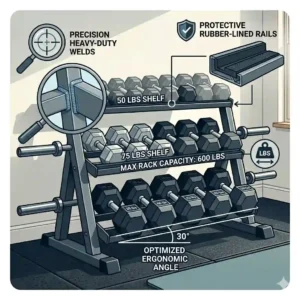
If you want the exact feel of a commercial gym in your garage, the REP Fitness Rubber Hex Dumbbell Set with 3-Tier Rack is the gold standard, featuring fully knurled, friction-welded handles.
The standout specification is the premium vulcanized rubber coating on the hex heads paired with a heavy-duty 11-gauge steel rack. What this means in your daily workout is profound: when you drop these dumbbells on a rubber mat, they bounce predictably and quietly, without vibrating the floorboards or waking up the kids. The 3-tier rack features an angled lip, meaning you don’t have to awkwardly contort your wrists to un-rack a 50-pound dumbbell—a massive ergonomic advantage when you’re fatigued.
I always steer intermediate to advanced lifters toward this set. The straight, fully knurled handle provides superior grip compared to the ergonomic (bulged) handles found on cheaper sets, which is crucial when your hands get sweaty during heavy rows. The spec sheet won’t tell you this, but the rubber off-gassing from REP is minimal compared to bargain brands. Buyer feedback heavily favors the secure grip and the rock-solid stability of the rack, though some mention the shipment arrives in a frustrating number of separate boxes.
-
✅ Commercial-grade vulcanized rubber minimizes noise and damage
-
✅ Angled 3-tier rack saves your lower back and wrists
-
✅ Straight, deeply knurled handles offer elite grip security
-
❌ Requires a significant amount of floor space (approx. 4 feet wide)
-
❌ Shipping logistics can be staggered and cumbersome
Price Range & Value Verdict: Ranging from $700 to $900 depending on the weight increments chosen, this is a “Buy It For Life” investment that completely justifies its mid-tier premium.
3. Rogue Fitness Urethane Dumbbell Set with 2-Tier Rack
The Rogue Fitness Urethane Dumbbell Set with 2-Tier Rack represents the apex predator of free weights, boasting ultra-durable polyurethane heads and strict weight tolerances.
The defining feature here is the urethane casing over solid steel heads, as opposed to rubber over cast iron. In real-world terms, urethane is practically indestructible, completely odorless from day one, and won’t leave black scuff marks on your walls or floors if you accidentally brush against them. The accompanying 2-tier rack is over-engineered with massive structural gussets, meaning even if you slam a 100-pound dumbbell onto the cradle, the rack won’t flinch.
This is strictly for the hardcore home gym owner or personal training studio. The precision machining means a 50-pound dumbbell weighs exactly 50 pounds (cheaper sets can vary by up to 5%). What surprised me most during use was the handle transition—the smooth slope from the knurling to the head prevents the pinch blisters common with blockier dumbbells. Reviewers universally praise the pristine aesthetic and durability, though the high cost of entry is a common sticking point.
-
✅ Urethane coating is odorless, non-marking, and bomb-proof
-
✅ Elite weight accuracy and machining tolerances
-
✅ Over-engineered rack feels bolted to the earth
-
❌ Extremely expensive compared to rubber hex options
-
❌ The 2-tier design requires a long wall space
Price Range & Value Verdict: Falling in the premium $1,000+ range, this set is undeniably expensive, but it caters perfectly to the buy-once-cry-once purist who demands perfection.
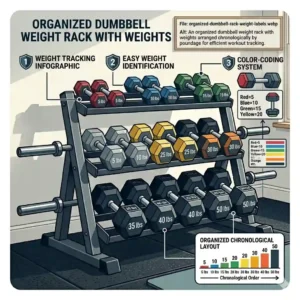
4. Bowflex SelectTech 552 Adjustable Dumbbells with Media Stand
While not a traditional rack of fixed weights, the Bowflex SelectTech 552 Adjustable Dumbbells with Media Stand fundamentally serves the same purpose using a dialed selection mechanism.
These dumbbells replace 15 sets of weights (from 5 to 52.5 lbs) using a unique dial system, and the accompanying media stand features a built-in device holder. Practically, this means you can transition from 10-pound lateral raises to 50-pound chest presses in about three seconds without moving your feet. The stand itself elevates the cradles to an ergonomic height, completely eliminating the need to bend over and pick weights off the floor.
For apartment dwellers or anyone turning a spare bedroom into a gym, this is my top recommendation. The space efficiency is unbeatable. However, the critical caveat I’ve found in practice is the bulkiness of the housing; even when you select 5 pounds, the dumbbell remains the physical length of a 52.5-pound bell, which can make movements like bicep curls feel slightly awkward until you adjust your form. Customer reviews consistently highlight the space-saving magic, though some report the dials can stick if exposed to dust over time.
-
✅ Unmatched space efficiency (replaces 15 pairs)
-
✅ Rapid weight changes keep workout momentum high
-
✅ Media stand perfectly positions a tablet for guided workouts
-
❌ Fixed length makes some exercises feel clumsy
-
❌ Internal plastic components cannot be dropped safely
Price Range & Value Verdict: Usually sitting in the $350-$450 range, the cost-per-pound value is staggering, making it the smartest logistical choice for tight quarters.
5. Epic Fitness 150-Pound Neoprene Dumbbell Set with Rack
The Epic Fitness Neoprene Dumbbell Set with Rack is a colorful, floor-protecting option designed primarily for high-intensity interval training (HIIT), barre, and physical therapy.
This set features a thick neoprene dip coating over cast iron and sits on a vertical plastic/light-steel tower. In a practical setting, the neoprene offers a tactile, warm grip that doesn’t get slippery when your hands sweat, and it entirely prevents the metallic clanking of traditional iron. The vertical tower is incredibly lightweight, meaning you can easily pick up the entire rack (when empty) and move it to a different room.
I often recommend this specifically for Peloton riders, barre enthusiasts, or older adults focusing on joint mobility rather than powerlifting. The hex-shape prevents rolling, but what I appreciate most is that the coating is exceptionally gentle on hardwood floors. However, buyers should be aware that the plastic tree-style rack can feel a bit flimsy when you’re quickly racking the heavier 15-pound bells. Most feedback celebrates the comfortable grip and aesthetic appeal, while noting the rack’s lightweight nature as a minor flaw.
-
✅ Neoprene coating is comfortable and floor-friendly
-
✅ Bright color-coding makes weight identification instant
-
✅ Perfect weight range (up to 15 lbs) for cardio and rehab
-
❌ Vertical tree rack lacks heavy-duty stability
-
❌ Neoprene can tear if scraped against sharp edges
Price Range & Value Verdict: At under $100, this is a highly accessible, low-commitment purchase that perfectly supplements an existing cardio routine.
✨ Don’t Miss These Exclusive Deals!
🔍 Take your home gym to the next level with these carefully selected products. Click on any highlighted item to check current pricing and availability. These tools will help you create authentic fitness results your family will love!
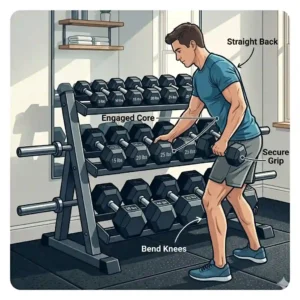
Transformation: The “First 30 Days” Setup & Maintenance Guide
Buying a dumbbell weight rack with weights is only the first step; how you integrate it into your home dictates its longevity. Over the years, I’ve seen too many people ruin their floors or complain about smells because they missed these crucial first-month steps.
1. The Unboxing and De-Gassing Protocol
If you bought rubber hex dumbbells, they will smell like a tire factory on day one. This is normal. The spec sheet doesn’t tell you this, but the trick is to unbox them in your garage or on a covered patio. Wipe each rubber head down with a mixture of warm water and a few drops of Dawn dish soap (avoid harsh chemicals, which dry out the rubber). Let them sit in a well-ventilated area for 48-72 hours before bringing them into an enclosed spare bedroom.
2. Protecting Your Subfloor
Never place a heavy, fully loaded metal rack directly on hardwood, laminate, or thin carpet. A loaded 3-tier rack puts immense PSI (pounds per square inch) on its four metal feet. Within a month, it will permanently dent your floor. Invest in a 3/4-inch vulcanized horse stall mat or a high-density gym tile, and place the rack on top. This dissipates the load and protects against accidental drops.
3. The 30-Day Hardware Check
Metal flexes, especially under the dynamic load of weights being slammed onto it daily. Thirty days after your initial assembly, take your socket wrench and tighten every single bolt on the rack. You will likely find that they have loosened by a quarter-turn. Doing this prevents long-term metal fatigue and sheer stress on the bolts.
Transformation: Finding Your Match: A Buyer’s Decision Framework
Still paralyzed by choice? I use a simple decision tree with my private clients to cut through the marketing noise. Ask yourself these three questions:
Scenario A: The Urban Apartment Dweller
-
Your Situation: You have a 10×10 space that doubles as an office. You cannot make noise that bothers downstairs neighbors.
-
The Prescription: You must opt for the Bowflex SelectTech 552 or a similar adjustable system. A traditional dumbbell weight rack with weights will consume 20% of your usable floor space, and dropping a fixed iron bell will guarantee a noise complaint.
Scenario B: The Garage Gym Powerlifter
-
Your Situation: You train for hypertrophy and strength. You have a dedicated garage bay and concrete floors. You superset heavy presses with rows.
-
The Prescription: Skip the A-frames and adjustable bells. You need a REP Fitness Rubber Hex Set on a horizontal 3-tier rack. Adjustable bells are too fragile for heavy, failure-based training (you can’t drop them), and the horizontal rack allows for lightning-fast weight swaps without pinching your fingers.
Scenario C: The Cardio & Core Enthusiast
-
Your Situation: Your primary workouts are cycling, yoga, Pilates, or follow-along HIIT videos. You rarely lift over 20 pounds.
-
The Prescription: The Epic Fitness Neoprene Set. You don’t need knurled steel tearing up your hands during high-rep shoulder presses. The soft neoprene is comfortable, and the vertical tower looks neat and unobtrusive in a living room setting.
How to Choose a Dumbbell Weight Rack with Weights
When evaluating specs, it’s easy to get lost in the numbers. Here are the core criteria you should actually care about, and why they matter in a real-world setting.
1. Rack Architecture: Vertical vs. Horizontal
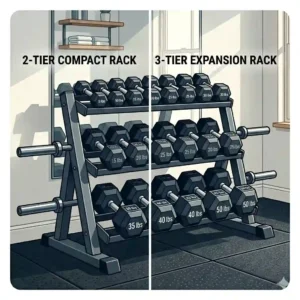
A-frame (vertical) racks are space savers, but they stack weights vertically. This means to grab the 25-pounders at the bottom, you have to stoop down, and navigating your hand between the tight slots can lead to pinched fingers. Horizontal tiered racks (2-tier or 3-tier) require more wall space but display the weights at a natural ergonomic height with an angled lip, which is vastly superior for your lower back when re-racking heavy loads.
2. Handle Ergonomics: Straight vs. Contoured
Most budget sets feature a contoured (ergonomic) handle that bulges in the middle. While this feels nice initially, it forces your hand into one specific grip width. For serious lifters, a straight, fully knurled handle is better. It allows you to shift your grip to the left or right to slightly alter the balance of the weight (useful for pronated bicep curls), and the aggressive knurling bites into your skin for safety during sweaty sessions.
3. Steel Gauge and Hardware
Look for 11-gauge or 12-gauge steel for the rack. Higher numbers mean thinner steel (14-gauge is thin). Furthermore, check if the manufacturer uses nyloc nuts (nuts with a nylon insert). Nyloc nuts won’t vibrate loose over time, whereas standard nuts and washers will require constant retightening.
Common Mistakes When Buying Your First Set
After auditing dozens of home gyms, I constantly see the same buying errors. Avoid these pitfalls to save yourself hundreds of dollars.
Buying Too Light for the Long Term
The most common mistake is buying a 5-25 lb set because it feels challenging today. According to the American Council on Exercise (ACE), the body adapts to resistance remarkably fast. Within six months of consistent training, a 25-pound dumbbell will feel like a feather for compound movements like goblet squats or chest presses. Always buy a set that includes weights at least 20% heavier than you can currently lift.
Ignoring Weight Capacity Limits
People often buy a cheap rack and later attempt to store heavier dumbbells on it. If a rack is rated for 200 pounds, loading 300 pounds onto it creates microscopic stress fractures at the weld points. One day, the rack will buckle, potentially causing severe injury. Always factor in the total weight of future expansions.
Falling for the “Chrome” Trap
Polished chrome handles and shiny racks look incredible in product photos. In reality, cheap chrome plating chips off. When it chips, the exposed steel rusts, and the sharp flakes of chrome can slice your hands during a lift. Stick to black powder-coated racks and zinc or raw steel handles.
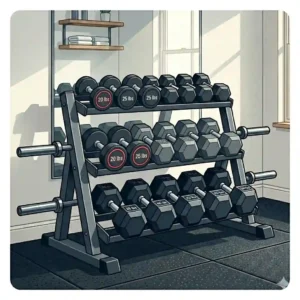
Hex vs. Round vs. Adjustable: Which Prevails?
Understanding the shape of the dumbbell head is critical for safety and workout versatility.
| Dumbbell Type | Floor Stability | Drop Safety | Best Use Case |
| Hexagonal | Excellent (No rolling) | High (if rubberized) | Push-ups, floor presses, general fitness |
| Round (Pro-Style) | Poor (Will roll away) | Very High | Commercial gyms, heavy isolation work |
| Adjustable | N/A (Kept in cradle) | Low (Fragile internals) | Small spaces, rapid drop-sets |
Expert Analysis: Hexagonal dumbbells are the undisputed king of the home gym. Because they feature flat edges, you can place them on the ground and use them as handles for renegade rows or dumbbell push-ups without them rolling out from under you—a critical safety feature. Round dumbbells are aesthetically pleasing and common in commercial gyms with perfectly level floors, but in a garage with a sloped concrete floor (for drainage), round bells will literally roll down the driveway. Adjustable systems win for space, but their complex plastic gears mean if you drop them once, you might break the selection mechanism permanently.
What to Expect: Real-World Performance & Floor Space
It is vital to translate catalog dimensions into living room realities. When a company says a 3-tier rack is 48 inches wide, they are only measuring the steel frame.
The Footprint Illusion
Once you load a 50-pound dumbbell onto the end of that rack, the bells themselves overhang the frame by 3 to 4 inches on each side. Furthermore, you need “elbow room.” If you wedge a 48-inch rack into a 50-inch alcove, you will smash your knuckles against the drywall every time you rack the outermost weights. You must leave at least 8 to 12 inches of clearance on both sides of any horizontal rack.
The “Dead Space” Behind A-Frames
A-frame racks are incredibly compact, but because of their triangular shape, you cannot push them completely flush against a wall. The bells on the back side of the tree require clearance. Expect an A-frame to sit roughly 6 to 8 inches off your wall, creating a small pocket of dead space that is notoriously difficult to vacuum around.
Long-Term Cost, Upgrades, & Maintenance
The total cost of ownership for a dumbbell weight rack with weights extends beyond the checkout cart. Free weights are a commodity, and iron isn’t getting any cheaper.
If you purchase a high-quality rubber hex set with an 11-gauge rack (like the REP Fitness set), your maintenance cost is effectively zero. A wipe-down with a damp cloth once a month is all it takes, and they will last 30 years.
Conversely, if you buy cheap cast-iron bells with baked enamel, the paint will chip. Your sweat, which is acidic, will seep into the cast iron and cause oxidation (rust). You will then find yourself spending time and money wire-brushing the rust off and re-spraying them with Rust-Oleum every two years.
Furthermore, consider the “Expansion Penalty.” If you buy a small rack that maxes out at 30-pound bells, and you eventually need 40s and 50s, you can’t just buy the heavier weights. You have to buy the heavier weights and an entirely new, larger rack, effectively paying for storage twice. This is why I aggressively advocate for buying a larger rack than you currently need. It is a strategic hedge against your own future strength gains, as supported by strength training protocols from the Mayo Clinic, which emphasize progressive overload.
✨ Don’t Miss These Exclusive Deals!
🔍 Ready to finally organize your workout space? Click on any highlighted item to check current pricing and availability. These tools will help you create an authentic home gym experience!
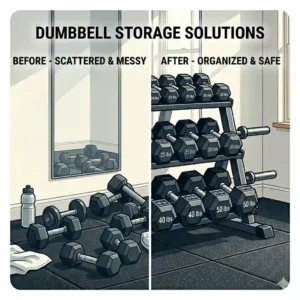
Conclusion: Making the Right Investment
Finding the right dumbbell weight rack with weights is a transformative step for any home gym. It transitions your space from a chaotic pile of trip hazards into a highly functional, welcoming environment that actually makes you want to train.
Remember, the spec sheet is only half the story. As we’ve explored, the real-world implications of rack geometry, handle knurling, and rubber off-gassing will dictate your day-to-day satisfaction far more than raw weight capacity alone. Whether you prioritize the indestructible nature of the Rogue Urethane set, the space-saving brilliance of the Bowflex SelectTech, or the budget-friendly accessibility of the CAP Barbell A-frame, your choice should reflect your specific living situation and fitness goals.
Don’t buy for the lifter you are today; buy the setup that will support the lifter you intend to become six months from now.
FAQs
❓ What is the best material for a dumbbell weight rack?
✅ Heavy-duty 11-gauge or 12-gauge steel with a powder-coated finish is best. This material resists bending under heavy loads and prevents rust. Avoid racks made entirely of plastic or thin tubular aluminum, as they degrade quickly…
❓ Can I put a dumbbell rack on an upstairs floor?
✅ Yes, but with caution. A fully loaded rack can weigh upwards of 400 lbs. Distribute the weight over a structural joist and always use a thick, high-density rubber mat (3/4-inch) to protect the subfloor from point-load damage…
❓ Do rubber dumbbells smell forever?
✅ No. Virgin rubber and urethane have almost no scent. Cheaper recycled rubber will off-gas a strong tire odor, but this naturally dissipates in a well-ventilated area within 2 to 4 weeks. Washing them with mild dish soap accelerates this…
❓ Are adjustable dumbbells better than a rack of weights?
✅ They are better for saving space and money, replacing up to 15 pairs of bells. However, traditional fixed weights on a rack are far more durable, allow for safe dropping, and won’t jam during intense, sweaty workouts…
❓ How much should I spend on a dumbbell set with a rack?
✅ For a quality 5-50 lb rubber hex set with a solid steel rack, expect to spend in the $600 to $900 range. Budget beginner sets (5-25 lbs) are available under $250, while premium commercial urethane setups exceed $1,200…
Recommended for You
- 5 Best steel dumbbells in 2026: Expert Lab Tests & Hidden Flaws Behind the Top Picks
- 5 Best Dumbbell Rack With Weights Options (2026 Expert Review)
- The Best one pound dumbbells for Toning & Rehab (2026 Guide)
Disclaimer: This article contains affiliate links. As an Amazon Associate, I earn from qualifying purchases. If you purchase products through these links, we may earn a small commission at no additional cost to you.
✨ Found this helpful? Share it with your friends! 💬🤗
[addtoany]
